走
Character Story & Explanation
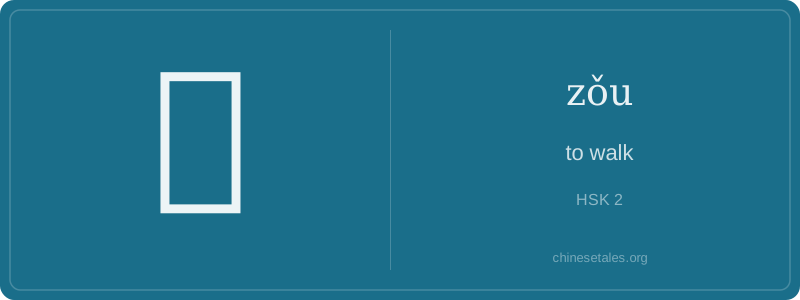
The earliest form of 走 appears in oracle bone inscriptions as a vivid pictograph: a human figure (the top part, later evolving into 土 + 止) with legs striding forward — specifically, the lower half shows two feet (止, zhǐ) in mid-step, one raised, one planted, radiating kinetic energy. Over centuries, the upper component simplified from a full person to a stylized '土' (earth) shape, while the 'foot' radical 止 remained anchored at the bottom — preserving the essence of locomotion. By the seal script era, the seven-stroke structure was locked in: three strokes above (like a tilted roof or hurried head), then the decisive four-stroke 'foot' below.
This visual urgency shaped its meaning: in the *Shuōwén Jiězì* (100 CE), 走 is defined as 'to run' — faster than 步 (bù, 'to walk')! Only later did its meaning broaden to general 'departure' or 'leaving'. Classical poets used it for poignant exits: Li Bai wrote '客从何处来?… 客已走' ('Where did the guest come from? … The guest has already gone'), where 走 conveys irrevocable, graceful vanishing — not plodding footsteps, but the silent dissolution of presence. Its shape still whispers motion: look closely — those final four strokes? They’re not static; they’re feet in flight.
Think of 走 (zǒu) as Chinese’s version of the English verb 'to go' — not just 'to walk', but the default, all-purpose motion verb that kicks things into gear. In English, we say 'I walk to school', but in Chinese, you’d almost always say 我走去学校 (wǒ zǒu qù xuéxiào) — even if you’re biking or taking the bus! That’s because 走 carries a sense of *initiating movement*, like pressing 'play' on life’s remote control. It’s less about footwork and more about 'getting underway'.
Grammatically, 走 is wonderfully flexible: it can stand alone ('Let’s go! — 走!'), pair with directional complements ('go out — 走出去'), or serve as a light verb in resultative compounds ('run away — 跑走'). Unlike English verbs, it rarely needs an object — 'He left' is simply 他走了 (tā zǒu le), where 走 le signals completed departure. Learners often over-translate it as 'walk' and awkwardly insert it where Chinese uses 更 (gèng), 很 (hěn), or even silence — e.g., never say *我走高* for 'I’m tall'; that’s nonsensical!
Culturally, 走 has quiet gravity: in classical texts, it signaled dignified exit (e.g., Confucius ‘walking away’ from corrupt courts), and today, 走人 (zǒu rén) means 'to be fired' — literally 'walk-person', like ejecting someone from the scene. A common blunder? Using 走 instead of 去 (qù) when specifying destination without implied motion — 'I go to Beijing' is 我去北京, not *我走北京. Remember: 走 = 'set off', 去 = 'head toward'.