路
Character Story & Explanation
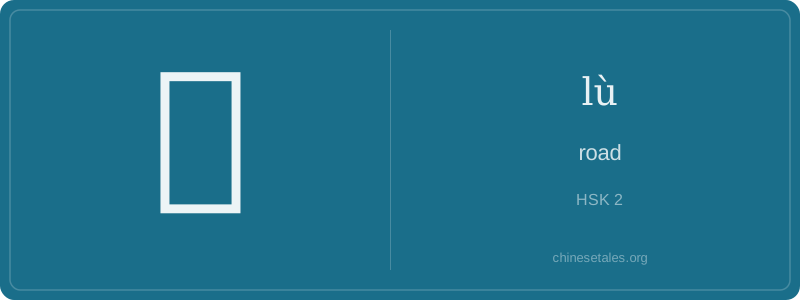
The earliest form of 路 appears in bronze inscriptions (c. 1000 BCE) as a composite: a walking person (⻊, later standardized as the 足 radical) striding confidently across two parallel horizontal lines — representing a cleared, leveled path through terrain. Over centuries, the top part evolved from a simplified pictograph of ‘each’ or ‘all’ (各, gè) — hinting at ‘a path open to all’ — into today’s (a stylized variant of 各). The bottom 足 radical stayed firmly rooted, anchoring the character in embodied motion: this is not an abstract concept, but something you step onto.
By the Han dynasty, 路 had expanded beyond dirt tracks to mean official routes, post roads, and administrative districts (e.g., 唐代的‘道’与‘路’并用, later standardizing 路 for regional divisions). In classical poetry — like Du Fu’s lament ‘国破山河在,城春草木深。感时花溅泪,恨别鸟惊心’ — though 路 doesn’t appear, its absence speaks volumes: when roads vanish, so does connection, order, and safety. Visually, those two horizontal strokes remain the ‘ground’ under foot — a quiet reminder that every great journey begins literally beneath your sole.
At its heart, 路 (lù) isn’t just a concrete ‘road’ — it’s a pathway of possibility: physical, metaphorical, and even existential. In Chinese, it carries warmth and openness: you don’t just ‘take’ a road, you ‘go on’ it (走上路), ‘find’ it (找路), or ‘lose’ it (迷路). Unlike English’s static ‘road’, 路 often implies movement, choice, or journey — think of the idiom 条条大路通罗马 (‘All roads lead to Rome’), where each 路 is a distinct path toward a goal.
Grammatically, 路 is a noun but flexes beautifully: it pairs with measure words like 条 (a long, linear thing — 一条路), appears in verb-object compounds like 带路 (‘to guide the way’), and even functions as a suffix meaning ‘method’ or ‘approach’ (e.g., 思路 ‘line of thought’, 出路 ‘way out’). Learners often overgeneralize and say *‘yī lù’ for ‘one road’ — but no: it’s 一条路 (yī tiáo lù), because 路 is countable only with 条, not 个 or 一.
Culturally, 路 evokes resilience and self-determination — hence phrases like 自己的路 (zìjǐ de lù, ‘one’s own path’) in motivational speeches, or the solemn weight of 死路 (sǐ lù, ‘dead end’), which isn’t just blocked — it’s existentially closed. A classic mistake? Using 道 (dào) and 路 interchangeably: 道 feels more philosophical or formal (e.g., 大道 ‘main thoroughfare’ or ‘The Dao’), while 路 is earthy, everyday, and human-scaled — the kind you walk on with your feet, not contemplate in silence.