跑
Character Story & Explanation
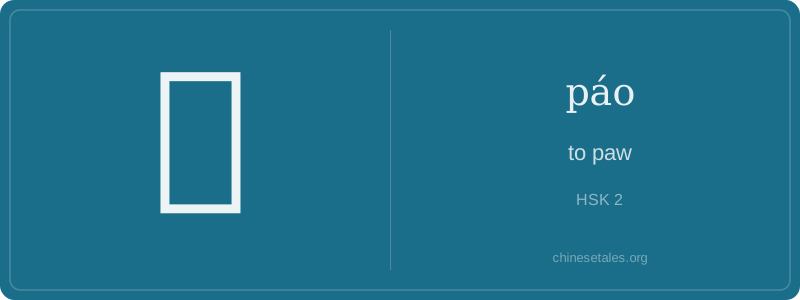
The earliest form of 跑 appears in Han dynasty clerical script, not oracle bones — it’s a relatively late arrival. Its left side, 足, was already a stylized ‘foot’ with three toes and an ankle line. The right side evolved from a variant of 包 that originally depicted a hand wrapping cloth around something — but scribes simplified it into the modern 包 shape by the Tang dynasty. Crucially, the 12 strokes weren’t arbitrary: the four dots in 足 (representing toes) plus the eight strokes of 包 create a rhythmic, ‘stamping’ visual cadence — like hoofbeats hitting earth. Even the slanting stroke in 包 mimics a forward-lunging claw.
This character didn’t exist in early Chinese; ‘to run’ was originally 走 (zǒu). 跑 emerged around the Northern and Southern Dynasties (420–589 CE) to specifically describe *non-human* rapid motion — horses, deer, even wind ‘pawing’ at grass. The Shuowen Jiezi (121 CE) doesn’t list it, but the Tang dynasty’s *Guangyun* rhyme dictionary confirms páo as ‘hoof-stamp; claw-scrape’. In Li Bai’s poetry, 跑 appears in lines describing wild stallions ‘páo shā’ (páoshā, ‘pawing sand’), where the character’s visual texture — sharp, angular, grounded — mirrors the grit and force of the action.
Let’s crack open 跑 (páo) like a linguistic walnut: it’s not the ‘run’ you know — that’s pǎo. At HSK 2, you’ll almost certainly encounter 跑 only in its classical, literary pronunciation páo, meaning ‘to paw’ or ‘to scrape with claws/hooves’. Think of a horse stamping its front hooves impatiently — that’s páo! Visually, it’s built from 足 (zú, ‘foot’) on the left, anchoring it to motion and limbs, and 包 (bāo, ‘to wrap’) on the right, which here isn’t about packaging — it’s a phonetic clue hinting at the ancient *p- sound* (and yes, 包 and 跑 *do* rhyme in Middle Chinese!). This is a prime example of how Chinese characters blend sound + sense — not just meaning.
Grammatically, páo appears almost exclusively in fixed classical expressions or poetic compounds — never as a standalone verb in modern speech. You’ll see it in phrases like 跑馬 (páomǎ, ‘to gallop’, lit. ‘paw-horse’) or in idioms describing restless, clawing motion — often metaphorical (e.g., anxiety ‘pawing’ at your chest). Learners mistakenly use páo where pǎo belongs — but that’s like saying ‘I shall walk swiftly’ when you mean ‘I’m sprinting!’: technically correct in Shakespearean English, but wildly out of place today.
Culturally, this dual pronunciation reflects Chinese’s living stratification: pǎo is the vibrant, everyday ‘run’ (HSK 1), while páo is its elegant, slightly archaic cousin — like wearing formal gloves to polish silver. A common trap? Assuming all ‘foot’-radical characters imply human locomotion. Not so! 跑 (páo) evokes animal energy — urgent, physical, grounded. It’s rarely taught in textbooks because it’s niche — but spotting it in poetry or historical texts is like finding a secret handshake from the Tang dynasty.