非
Character Story & Explanation
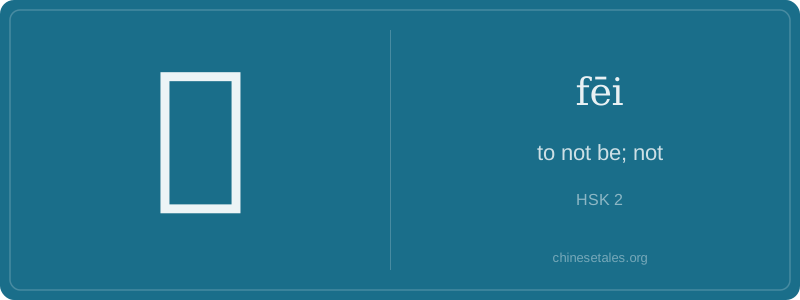
Carve this image into your mind: in oracle bone script (c. 1200 BCE), 非 looked like two parallel feathered wings — — drawn side-by-side, not overlapping. Why wings? Because early scribes used them to symbolize *separation* or *duality*: two things that do not belong together, like birds flying apart. Over centuries, those graceful feathers hardened into rigid, symmetrical strokes — first in bronze inscriptions, then seal script — until the modern form emerged: eight clean, mirrored strokes (two verticals flanked by four short horizontals each), embodying perfect, deliberate opposition.
This visual symmetry became semantic symmetry: 非 didn’t just mean ‘not’ — it meant ‘the opposite of what is proper, true, or aligned’. In the *Analects*, Confucius says: ‘是是非非谓之知’ (shì shì fēi fēi wèi zhī) — ‘To affirm what is right and reject what is wrong: that is wisdom.’ Here, 非 isn’t passive denial; it’s active moral discernment. The character’s mirrored structure mirrors this balance: truth and falsehood are not random opposites — they’re defined in strict, visible relationship to one another.
At its heart, 非 isn’t just a dry ‘not’ — it’s a firm, almost physical rejection. Think of it as slamming a door on falsehood, impossibility, or social impropriety. In Classical Chinese, it carried moral weight: to call something 非 was to declare it *unjust*, *unethical*, or *against the Way* (Dao). That gravity lingers today: 非常 (fēi cháng) literally means ‘not ordinary’, yet we say it for ‘very’ — a delightful paradox where negation intensifies meaning.
Grammatically, 非 shines in formal or literary contexts. You’ll rarely hear it alone in speech (we say 不 instead), but it’s indispensable in compounds like 非常、非法 (fēi fǎ, ‘illegal’), and 非常抱歉 (fēi cháng bào qiàn, ‘deeply sorry’). Learners often mistakenly swap it with 不 in casual sentences — saying *‘我非想去’* instead of *‘我不想去’* — which sounds stiff, archaic, or even sarcastic. Remember: 非 is the velvet glove on a steel fist — elegant, precise, and reserved for weighty negations.
Culturally, 非 reflects China’s deep-rooted preference for relational truth over absolute binaries. It doesn’t just mean ‘no’ — it implies contrast against an unspoken standard (e.g., 非礼 = ‘not according to ritual propriety’). This echoes Confucian thinking: morality isn’t abstract, but defined by harmony within roles and rules. That’s why you’ll see it in legal terms (非法), ethical judgments (非分之想, ‘an unwarranted desire’), and even internet slang (非酋, ‘non-ace’ — someone perpetually unlucky).