零
Character Story & Explanation
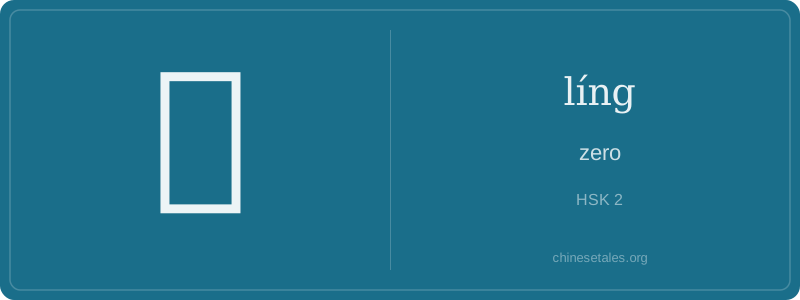
Oracle bone inscriptions show no direct precursor to 零, but its earliest bronze script form (c. 1000 BCE) already featured the rain radical (雨) atop a phonetic component likely related to 令 (lìng). Over centuries, the top stabilized as the standard 雨 radical (8 strokes: horizontal, dot, dot, dot, dot, horizontal, left-falling, right-falling), while the bottom evolved from 令 into today’s simplified 令-like shape (5 strokes: horizontal, vertical, horizontal, vertical,捺). By the Han dynasty, the full 13-stroke structure was fixed — a visual metaphor: rain falling in isolated, individual drops.
This imagery directly shaped its meaning: early texts like the Shuōwén Jiězì (121 CE) defined 零 as ‘falling drop by drop’ (tuō luò yě), describing rain, tears, or petals descending separately. Only much later — during the Ming and Qing dynasties — did it absorb the Indian-Arabic concept of ‘zero’ as a numerical placeholder, likely because both ideas shared the essence of ‘a counted absence’. So when you write 零, you’re literally writing ‘rain falling in single, silent units’ — and that quiet precision became the perfect vessel for mathematical zero.
At first glance, 零 (líng) means 'zero' — but in Chinese, it’s far more poetic and atmospheric than its math-class reputation suggests. Unlike English ‘zero’, which often signals emptiness or failure (‘zero tolerance’, ‘zero chance’), 零 evokes falling raindrops, scattered fragments, or quiet absence — think of the hush before a storm or loose change jingling in your pocket. Its core feeling is *dispersed nothingness*: not void, but gentle, natural, almost lyrical absence.
Grammatically, it’s deceptively versatile: as a numeral (0 in numbers like 105 → yī bǎi líng wǔ), as an adjective meaning ‘scattered’ or ‘fragmented’ (零钱 língqián — ‘loose change’), and even as a verb in classical phrases like 零落 (língluò — ‘to wither and scatter’). Learners often overuse it as a standalone noun ('I have zero money' → *wǒ yǒu líng qián* ❌); correct usage requires context or compound words — you say 没有钱 (méi yǒu qián), not *有零钱* to mean ‘have no money’.
Culturally, 零 reveals how Chinese integrates abstraction with nature: its rain radical (雨) reminds us that ‘zero’ isn’t sterile — it’s part of a cycle, like rain evaporating and returning. A common mistake? Pronouncing it as ‘lǐng’ (like 领) — but it’s always líng, with a level second tone. And don’t confuse it with 灵 (líng, ‘spirit’) — same sound, totally different world.