颜
Character Story & Explanation
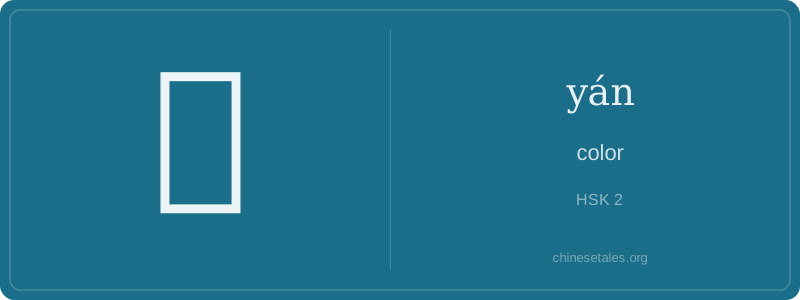
The earliest form of 颜 appears in bronze inscriptions (c. 1000 BCE) as a composite pictograph: a head (页, yè, originally depicting a person’s skull and hairline) topped by a simplified representation of a colored pigment vessel or dye vat (the top part, later stylized as 亠 + 丷 + 一 + 豕). Over centuries, the ‘dye’ component evolved into the upper structure we see today (the 15-stroke arrangement), while the lower 页 radical anchored its association with the human face — the first surface upon which color visibly manifests: flush, pallor, blushing, or makeup.
This visual logic shaped its semantic journey: from ‘pigment applied to the face’ → ‘facial complexion’ → ‘outward appearance’ → ‘dignity’ (as in classical texts like the Analects, where Confucius praises ‘a serene countenance’ — 颜色不怒而威). By the Han dynasty, 颜 was already embedded in idioms like 和颜悦色 (hé yán yuè sè, ‘gentle countenance, pleasant expression’), proving that for millennia, Chinese thinkers saw color not as abstract spectrum, but as the living, breathing signature of the human soul on the skin.
Think of 颜 (yán) not as a bland 'color' label like the English word, but as the *face* of color itself — like calling a painting ‘Vermeer’s palette’ when you really mean his luminous, breathing skin tones. In Chinese, 颜 rarely stands alone meaning ‘color’ in everyday speech (unlike English); instead, it lives inside compound words and poetic or formal contexts, carrying connotations of surface appearance, dignity, and even moral bearing — much like how ‘countenance’ in Shakespearean English means both ‘face’ and ‘inner character made visible’.
Grammatically, 颜 almost never appears without a modifier: you’ll see it in nouns like 颜色 (yánsè, ‘color’) or 颜面 (yánmiàn, ‘face/dignity’), but never say *‘zhè shì yán’* (‘this is color’) — that would sound bizarre, like saying ‘this is countenance’ in English. Learners often overgeneralize it as a free-standing noun; remember: 颜 is a *root*, not a word — it’s the ‘chroma’ in ‘chromatic’, not the ‘red’.
Culturally, 颜 quietly anchors ideas of social presence: losing face is 丢脸 (diū liǎn), but preserving dignity is 保全颜面 (bǎoquán yánmiàn). A common slip is confusing it with 彩 (cǎi, ‘brilliant color; hue’) — which evokes festive, vivid shades (e.g., 彩虹 cǎihóng, ‘rainbow’), while 颜 leans toward solemn, human-centered resonance: your blush, your pallor, your gravitas.