馆
Character Story & Explanation
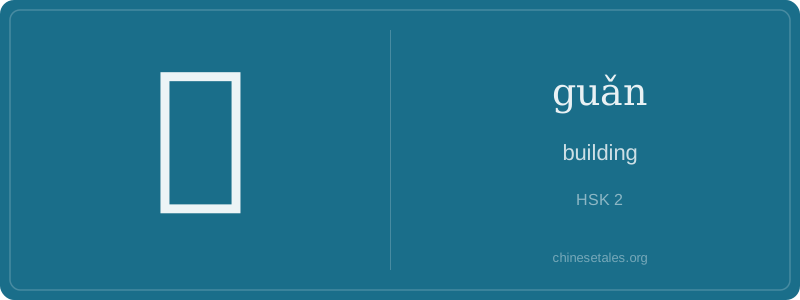
The earliest form of 馆 appears in seal script, evolving from a combination of 食 (shí, 'to eat') on the left — later simplified to the food radical 饣 — and 官 (guān, 'official, government') on the right. In oracle bone inscriptions, there was no direct pictograph; instead, the character emerged during the Warring States period as a phonosemantic compound: the food radical hints at sustenance/hospitality, while 官 provides both sound (guān → guǎn) and meaning (a government-run facility). The 11 strokes crystallized in clerical script: three dots (饣) for food, then 官 — which itself contains 宀 (roof) over 珽 (a ceremonial jade, later simplified to 㠯 + 一). So visually: 'food under official roof' → a state-provided lodging or dining hall.
This origin explains everything: ancient 馆 were government guesthouses for traveling officials, providing meals and shelter — hence the food radical anchoring its essence. By the Tang dynasty, 馆 expanded to include literary salons (如翰林院下属的‘集贤馆’ Jíxián Guǎn) and libraries. In classical texts like the *Zuo Zhuan*, 馆 appears in contexts like 'setting up a guesthouse for envoys'. Even today, the food radical isn’t about cooking — it’s about care, provision, and welcoming. That’s why a modern coffee shop might brand itself as a 咖啡馆 (kāfēiguǎn): not because it serves dumplings, but because it’s a curated, hospitable space — a tiny continuation of the ancient official’s rest stop.
At first glance, 馆 (guǎn) might seem like a simple 'building' — but in Chinese, it’s never *just* a building. It’s a building with purpose, identity, and hospitality baked into its bones. Think of it as a ‘function-specific venue’: a place where something meaningful happens — eating, learning, resting, or representing. You’ll almost never use it alone like English 'building'; instead, it appears in compound nouns: 图书馆 (túshūguǎn, library), 饭馆 (fànguǎn, restaurant), or 领事馆 (lǐngshìguǎn, consulate). Its core feeling is warmth + function — not concrete and steel, but invitation and role.
Grammatically, 馆 is always a noun — never a verb or adjective — and almost always appears as the *second character* in two-syllable compounds. Learners sometimes wrongly insert it after verbs ('I visit library' → *wǒ qù túshūguǎn*, not *wǒ qù túshū guǎn* — no space!) or confuse it with generic terms like 楼 (lóu, 'floor/building'). Remember: if it serves a social or cultural function (serving food, storing books, hosting diplomats), it’s likely a -guǎn. And crucially: you wouldn’t call your apartment or office building a 馆 — that’s a 楼 or 房子. 馆 implies public service or shared activity.
Culturally, 馆 carries echoes of imperial China’s guesthouses (驿馆 yìguǎn) and scholarly academies (书院 shūyuàn, though not using 馆, they share its ethos). Modern usage still reflects this: even a small noodle shop proudly calls itself a 馆 — signaling pride in craft and welcome. A common mistake? Using 馆 for any indoor space — but no! A gym is 健身房 (jiànshēnfáng), not 健身馆 (though some do say that colloquially, it’s less standard). Stick to the classics: food, books, diplomacy, culture.