定
Character Story & Explanation
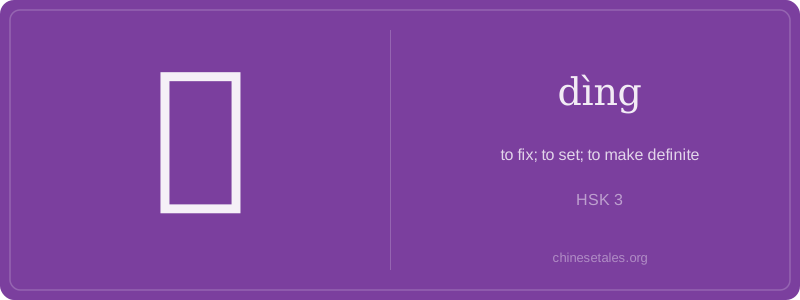
The earliest form of 定 appears in Western Zhou bronze inscriptions as a pictograph showing a person (represented by the top component 亠 + 丶, later evolving into the roof radical 宀) standing firmly over a ‘drip’ or ‘drop’ shape (originally 丁, which looked like a nail or stake). Over centuries, the upper part standardized into 宀 (roof), symbolizing shelter or containment, while the lower 丁 (dīng) remained—evoking something driven down, anchored, unshakable. By the Small Seal Script, the structure solidified: 宀 overhead, 丁 below—literally ‘a roof securing a stake’.
This visual logic shaped its meaning: from ‘driving a stake to mark territory’ (early ritual land demarcation) to ‘establishing boundaries,’ then ‘making firm,’ and finally ‘deciding conclusively.’ Confucius used 定 in the Analects (12.15) to describe the ideal ruler’s virtue: ‘The people… will be settled (定) when the ruler is upright.’ Here, 定 isn’t passive safety—it’s the direct result of moral clarity and decisive action. The character’s architecture—roof + nail—still whispers that truth: true stability comes not from waiting, but from anchoring intention under shelter of purpose.
At its heart, 定 isn’t just about ‘fixing’ something physically—it’s about bringing order to uncertainty, calming mental or social turbulence. Think of it as the linguistic equivalent of taking a deep breath and saying, ‘Okay—this is settled.’ In Chinese thought, stability isn’t passive; it’s an active, intentional achievement—whether setting a date, deciding a policy, or resolving doubt. That’s why 定 appears in words like 决定 (jué dìng, ‘to decide’) and 肯定 (kěn dìng, ‘certainly’): it carries quiet authority, not rigidity.
Grammatically, 定 shines in resultative and complement constructions. You’ll see it after verbs: 想定 (xiǎng dìng, ‘think through and settle on’), 看定 (kàn dìng, ‘decide on after inspection’). It also functions adverbially in fixed phrases like 一定 (yī dìng, ‘definitely’)—where the number 一 intensifies the sense of unwavering certainty. Learners often misplace it, trying to use 定 alone as a verb like ‘to fix’ (e.g., *我定它), but it almost never stands solo without a preceding verb or modifier.
Culturally, 定 reflects a deep-rooted value: clarity through commitment. Unlike English ‘set,’ which can be neutral or temporary (‘set the table’), 定 implies irrevocability—hence 定婚 (dìng hūn, ‘to become engaged’) is a formal, socially witnessed act. A common mistake? Confusing 定 with 停 (tíng, ‘to stop’) or 安 (ān, ‘peaceful’)—but 定 isn’t about cessation or calmness; it’s about resolution. It’s the moment the gavel falls—not the silence that follows, but the decision that creates it.