力
Character Story & Explanation
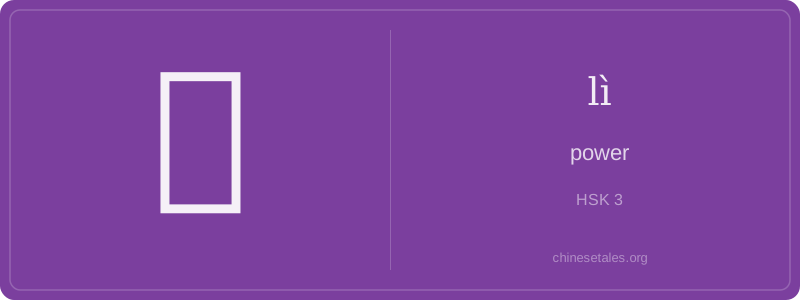
The earliest form of 力 appears on Shang dynasty oracle bones (c. 1200 BCE) as a bold, angular pictograph: a bent arm with a prominent elbow and clenched fist — no fingers shown, just raw leverage. Think of a farmer heaving a plow handle or a warrior drawing a bowstring. Over centuries, the curved forearm straightened into the top stroke (), and the fist condensed into the downward diagonal hook (丿) — giving us today’s minimalist, two-stroke form: a decisive, muscular slash from upper right to lower left.
This visual economy reflects its semantic journey: from literal physical force (《诗经》: ‘力如虎’ — ‘strong as a tiger’) to abstract potency (Mencius’ ‘仁者无敌,其力也大矣’ — ‘a humane person is invincible; their *power* is immense’). Even in modern usage, the shape echoes action: that downward stroke mimics the arc of a punch or a push — a silent grammar of exertion. No wonder it anchors words like 助力 (‘to assist’) and 压力 (‘pressure’): every compound inherits that original, embodied thrust.
Imagine you’re at a Beijing park at dawn: an elderly man stands barefoot, arms raised in slow-motion tai chi — not straining, but channeling invisible energy through his palms. That quiet, focused intensity? That’s 力 (lì) — not brute muscle power, but *intentional, cultivated force*: physical strength, mental effort, or even political influence. In Chinese, 力 isn’t just ‘power’ as in electricity; it’s the *capacity to act*, whether lifting a box (力气), solving a problem (努力), or asserting authority (权力). It feels grounded, purposeful, almost dignified — never reckless.
Grammatically, 力 rarely stands alone. You’ll see it bound tightly in compounds: as a noun (力量 ‘strength’, 能力 ‘ability’) or embedded in verbs like 努力 (nǔ lì, ‘to strive’ — literally ‘make effort’). Learners often mistakenly use 力 where English says ‘power’ in abstract contexts — e.g., saying *‘the power of love’* as 爱的力 — but native speakers say 爱的力量 (love’s *strength*, not *force*). Why? Because 力 implies tangible, exerted capacity — not mystical or emotional essence.
Culturally, 力 carries Confucian weight: strength without virtue (德) is dangerous. The Analects warns against ‘force without benevolence’ — so 力 always hints at responsibility. A common slip? Confusing it with the verb ‘to do’ (做) or the particle ‘le’ (了). But 力 is a noun — and its two-stroke simplicity hides depth: it’s one of only ~20 characters that serve *both* as a standalone character *and* as its own radical.