法
Character Story & Explanation
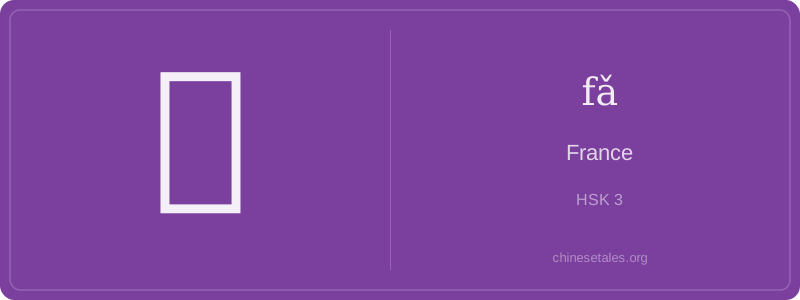
The earliest form of 法 (in bronze inscriptions, c. 1000 BCE) was 灋 — a far more complex character: it combined 氵 (water), 廌 (a mythical one-horned 'justice beast'), and 去 (to remove). The beast would gore the guilty, and 'water' symbolized impartiality — washing away bias. Over centuries, 廌 and 去 simplified dramatically: 廌 lost its horn and legs, 去 shrank, and by the Han dynasty, 灋 had streamlined into today’s 法 — keeping only 氵 and the right-hand component (now written 去 but historically derived from 廌+去).
This visual reduction mirrors a profound semantic shift: from a vivid mythic ritual of divine justice to an abstract concept — 'standard', 'law', 'method'. Confucius praised 'the Way and its methods' (dào yǔ fǎ), while Legalist philosophers like Han Feizi made fǎ the cornerstone of statecraft: impersonal, codified rules over moral persuasion. Even today, when Chinese speakers say yī gè hǎo fǎ (a good method), they echo that ancient ideal — not just 'how to do something', but 'the right, tested, authoritative way'.
Imagine you’re at a Beijing café, and your friend points to a croissant on the menu and says, 'Zhè shì Fǎguó de diǎn xīn!' — 'This is French pastry!' You blink: wait, 法 means *France*? But earlier you saw it on a sign for 'traffic law' (jiāo tōng fǎ) and in your textbook as 'method' (bàn fǎ). That’s 法’s magic: it’s a semantic chameleon. At its core, 法 carries the idea of 'a prescribed way' — whether that’s a legal code, a scientific principle, or a nation whose systems and customs define its identity in Chinese eyes.
Grammatically, 法 almost always appears as the second character in two-syllable nouns (Fǎguó, bàn fǎ, xiàn fǎ), never alone in speech. Learners sometimes mistakenly say *Fǎ* instead of *Fǎguó* — but just like we say 'Germany' not 'Ger-', Chinese requires the full compound. Also, don’t confuse it with verbs: 法 isn’t used as a verb ('to France') — it’s strictly nominal. And crucially: it’s never written without the water radical 氵, even though 'France' has no obvious connection to water — more on that mystery in the story!
Culturally, 法 as 'France' reflects late 19th-century transliteration logic: *Fǎ* approximated the French 'Fra-' (as in *Franche-Comté*) via Mandarin phonetics, while 氵 was added to slot it into the existing character system — much like how 美 (Měi, USA) got its 'sheep' radical for sound, not sense. A common error? Writing 法 as 法 without the three-dot water — but that’s not just sloppy; it’s illegible. The radical anchors it as a real Chinese character, not a foreign abbreviation.