化
Character Story & Explanation
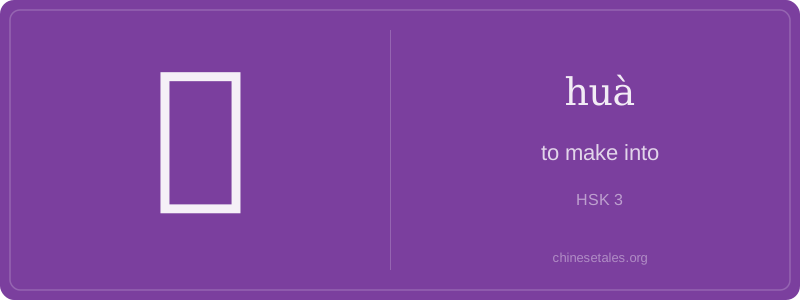
The earliest form of 化 appears in oracle bone inscriptions as two mirrored figures—one upright, one inverted—suggesting reversal or mutual transformation, like yin and yang swapping places. Over time, the left side simplified into the radical 匕 (bǐ), originally a spoon but here stylized as a ‘reversal marker’, while the right side evolved from a kneeling person (人 rén) flipped upside-down—visually encoding the idea of turning, inversion, and metamorphosis. By the seal script era, it had settled into its current four-stroke shape: 匕 + 人, with the person literally ‘flipped’ by the spoon-like radical.
This visual duality shaped its meaning: in the *Zhuangzi*, 化 describes the seamless flow between life and death—‘the ten thousand things transform without ceasing’. Later, in Neo-Confucian texts, it became central to moral cultivation: one doesn’t just ‘learn’ virtue, one *transforms into it* (内化 nèi-huà: ‘internalization’). Even today, the character’s structure whispers its secret: the ‘spoon’ (匕) isn’t stirring soup—it’s flipping reality itself.
Imagine you’re watching a magician wave a wand over an ordinary teacup—and *poof*—it transforms into a soaring phoenix. That ‘poof’ moment? That’s 化 (huà). It doesn’t just mean ‘change’; it means *fundamental, often invisible, internal transformation*: ice melting into water, a caterpillar becoming a butterfly, or even abstract ideas shifting—like prejudice ‘transforming into’ empathy. It’s the quiet alchemy behind all deep change.
Grammatically, 化 is almost always a verb suffix (e.g., 现代化 xiàndài-huà: ‘to modernize’) or part of compound verbs (e.g., 消化 xiāohuà: ‘to digest’). Crucially, it rarely stands alone—it needs context: you wouldn’t say ‘I huà the book’; you’d say ‘I *translated* the book’ (翻译 fānyì) or ‘I *adapted* it’ (改编 gǎibiān)—but if you say 这本书被本土化了 (zhè běn shū bèi běntǔ-huà le), you mean it’s been *deeply transformed to fit local culture*. Learners often mistakenly use 化 where simple verbs like 变 (biàn) or 改 (gǎi) would be more natural—especially in casual speech.
Culturally, 化 carries philosophical weight: in Daoism and Confucianism, it evokes effortless, natural transformation (‘the Way transforms without force’). Also watch tone—huà is fourth tone, not second (huá) or third (huǎ). Mispronouncing it as huá might get you ‘slippery’ (滑) instead of ‘transformed’!