自
Character Story & Explanation
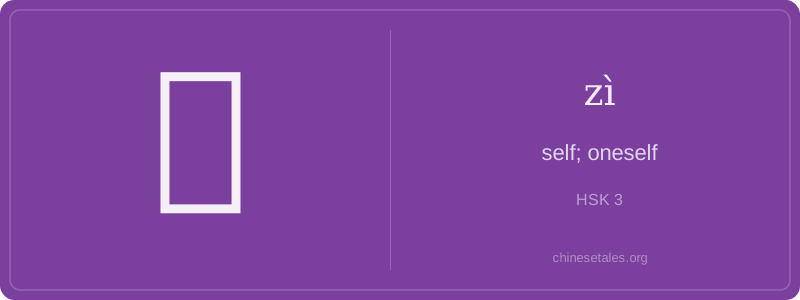
The earliest form of 自 appears in oracle bone inscriptions (c. 1200 BCE) as a vivid pictograph: a stylized nose — nostrils flared, bridge arched, even subtle lines suggesting nasal hairs! Ancient Chinese associated the nose with breath, life-force, and personal identity ('I am the one breathing this air'). Over centuries, the curved nostril shapes simplified into the top arc (⺝), the vertical stroke became the nose bridge, and the two short diagonal strokes evolved into the lower 'legs' — not legs at all, but abstracted contours of the nasal cavity opening downward. By the seal script era, it had solidified into a six-stroke structure that still echoes that ancient snout.
This nose-origin explains everything: in classical texts like the Analects, 自 is used to mark spontaneous, innate action — 'as if arising from one’s own breath.' The Mencius says 自得 (zìdé, 'genuine understanding') — knowledge that ‘arises from oneself,’ like breath, without coercion. Even today, the visual echo remains: trace the character — start at the top curve (like the arch of a nose), descend firmly down the bridge, then flare outward at the base. You’re not drawing a person — you’re sketching the first thing you see when you look inward: your own face, centered on the nose, the literal and figurative point of self-perception.
At its heart, 自 (zì) is the anchor of Chinese selfhood — not in a narcissistic way, but as the quiet, grammatical center from which action, reflection, and identity radiate. It’s never used alone as a noun like 'I' or 'me'; instead, it’s the building block for reflexive, autonomous, and intrinsic concepts: 自己 (zìjǐ, 'oneself'), 自然 (zìrán, 'naturally'), 自学 (zìxué, 'to study independently'). Think of it less as a pronoun and more as a semantic prefix that says: 'this originates from within, no external force needed.'
Grammatically, 自 almost always appears in compounds — rarely solo except in classical or poetic contexts. Learners often mistakenly try to replace 我 (wǒ, 'I') with 自, leading to nonsensical sentences like *自去学校 (×). No — 自 doesn’t mean 'I'; it means 'self-originating'. So while 我自己 (wǒ zìjǐ) means 'myself' (emphatic), 自己 alone means 'oneself' (generic or context-dependent). Also watch tone: zì is fourth tone — flat and decisive — unlike similar-sounding zí (second tone, rare) or cì (fourth tone, 'time/occasion').
Culturally, 自 carries Confucian weight: 自省 (zìxǐng, 'self-reflection') isn’t just introspection — it’s moral accountability. And in modern usage, 自- compounds signal agency: 自驾 (zìjià, 'self-driving'), 自助 (zìzhù, 'self-service') — reflecting China’s rapid shift toward individual initiative. A common trap? Over-translating 自 as 'self' in every compound: 自由 (zìyóu) means 'freedom', not 'self-freedom' — here 自 conveys 'intrinsic, uncoerced' essence. Let the character breathe; don’t force English logic onto it.