实
Character Story & Explanation
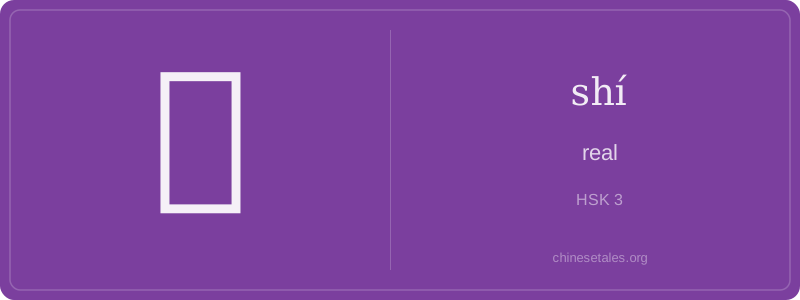
The earliest form of 实 appears on Western Zhou bronze inscriptions (c. 1000 BCE) as a complex pictograph: a roof 宀 sheltering a field (represented by 田) filled with grains — sometimes depicted as three rice stalks (宀 + 田 + 三 dots or strokes). Over centuries, the field simplified into 二 (two horizontal lines), the grain stalks merged into the lower component 丷 + 大 (which later became the modern bottom part), and the whole structure condensed into today’s elegant 8-stroke form: 宀 overhead, then 二, then 丷, then 大 — a visual promise of fullness under shelter.
This origin explains everything: real = what is concretely stored, harvested, and protected. In the Classic of Poetry, 实 describes abundant harvests; by the Han dynasty, it extended metaphorically to ‘substance’ (as in 实学, ‘practical learning’), opposing empty rhetoric. Even today, the character’s roof-and-grain architecture whispers its ancient logic: reality isn’t abstract — it’s what you can store, measure, and depend on. The bottom 大 (dà, ‘big’) isn’t accidental — it signals abundance, not size, reinforcing that ‘real’ means richly substantial, not merely present.
At its heart, 实 isn’t just ‘real’ like a dictionary definition — it’s the Chinese cultural weight behind authenticity, substance, and tangible truth. Think of it as the opposite of fluff: a professor praising a student’s 实 in their research means they value rigor over eloquence; calling a promise 实 implies it’s backed by action, not just words. This character carries quiet moral gravity — to be 实 is to be trustworthy, grounded, and unpretentious.
Grammatically, 实 shines as both an adjective (shí) and part of compound verbs like 实现 (shí xiàn, ‘to realize [a dream]’) or 实施 (shí shī, ‘to implement [a policy]’). Crucially, it’s rarely used alone as a standalone noun like ‘reality’ — you won’t say *‘this is 实’*; instead, you’ll say 这很实在 (zhè hěn shí zài, ‘this is very down-to-earth/practical’) or 事实 (shì shí, ‘fact’). Learners often over-translate ‘real’ and force 实 where Mandarin uses 到底 (dào dǐ), 真 (zhēn), or even silence.
Culturally, 实 reflects Confucian pragmatism: valuing concrete contribution over abstract brilliance. A boss might praise an employee’s 实干精神 (shí gàn jīng shén, ‘spirit of practical work’) — a phrase that sounds almost heroic in Chinese but would sound oddly mechanical in English. And watch out: 实 in negative contexts like 不实在 (bù shí zài) doesn’t mean ‘unreal’ — it means ‘dishonest’ or ‘unreliable’, revealing how deeply ethics and tangibility are fused in this single character.