加
Character Story & Explanation
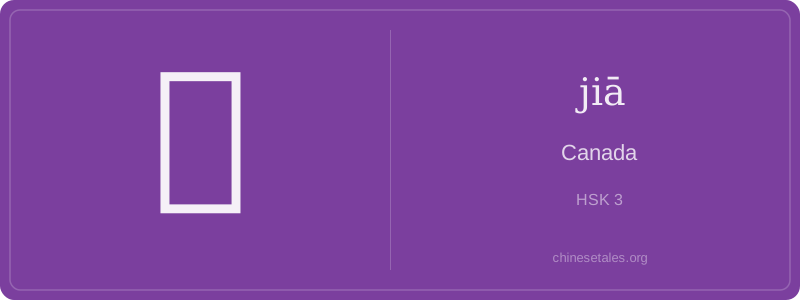
The earliest form of 加 appears in bronze inscriptions around 1000 BCE: a pictograph combining 口 (kǒu, mouth or container) atop 力 (lì, strength/power), suggesting ‘pressing force onto something contained’. Over time, 口 evolved into the top component 丷 + 口-like shape (now written as + 口 in seal script), while 力 remained unmistakably the radical — a visual anchor of exertion. By the Han dynasty clerical script, the strokes simplified into today’s clean five-stroke form: the two short diagonal strokes (丷), the horizontal stroke, the vertical stroke with hook, and finally the distinctive curved stroke of 力 — all flowing downward like energy being applied.
This physical image — force applied to a vessel — anchored its meaning: ‘to add by applying effort’. In the *Analects*, Confucius uses 加 in phrases like ‘bù kě jiā yě’ (‘cannot be added to’), referring to moral qualities that can’t be artificially inflated. By the Tang dynasty, 加 expanded into bureaucratic language (‘jiā guān’ — bestow an official title) and everyday speech. Crucially, its 力 radical never faded — a constant reminder that in Chinese thought, addition isn’t passive accumulation; it’s deliberate, powered action.
Imagine you’re at a bustling Beijing breakfast stall, and the vendor shouts, 'Yào jiā yī ge jīdàn ma?' (Want to add an egg?). That ‘jiā’ isn’t just about eggs — it’s the quiet engine of Chinese grammar: the verb for *adding*, *increasing*, or *including* something extra. It carries a sense of intentionality and augmentation — not passive growth, but active addition, like topping up your tea, boosting your effort, or even amplifying emotions ('jiā shēn' — deepen one’s understanding). Unlike English ‘add’, 加 rarely stands alone; it almost always pairs with another verb (e.g., 加快, 加强) or appears in structures like ‘jiā…shàng’ (add…on) or ‘jiā yǐ’ (to + verb, formal).
Grammatically, 加 is versatile but precise: it’s a transitive verb requiring an object (‘jiā yī gè rén’ — add one person), and in compound verbs, it intensifies meaning (‘jiā kuài’ = speed up, literally ‘add fast’). Learners often mistakenly use it like English ‘plus’ in math — but that’s actually the character ‘+’ or the word ‘jiā hào’. Also, 加 never means ‘Canada’ — that’s a common trap! The English word ‘Canada’ is transliterated as ‘Jiānádà’, using different characters entirely. This confusion arises from mishearing the pinyin, not from the character itself.
Culturally, 加 reflects a pragmatic, incremental mindset — think ‘jiā bān’ (overtime work), ‘jiā liàng’ (increase quantity), or ‘jiā yóu’ (literally ‘add oil’, the beloved Chinese cheer meaning ‘Go for it!’). Its frequent use in slogans, policy documents, and daily encouragement reveals how deeply Chinese values prioritize continuous improvement — not perfection at once, but steady, conscious addition. Mastering 加 means mastering the rhythm of effort, growth, and thoughtful enhancement in Chinese life.