心
Character Story & Explanation
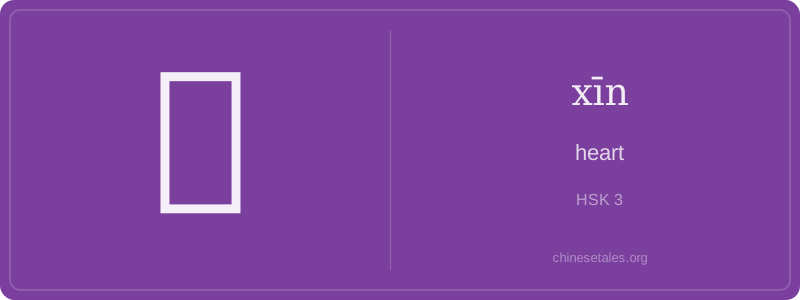
Trace back 3,300 years to oracle bone script, and 心 looks like a wobbly, asymmetrical outline of a human heart — three lobes, a ventricle, maybe even a pulse line. Bronze inscriptions refined it into a smoother, more symmetrical vessel with a dot inside representing life-force or blood. By the small seal script era, it had simplified to a rounded 'box' with three distinct interior strokes — the top dot and two downward curves — evolving into today’s clean, compact four-stroke form: 点 (diǎn), 卧钩 (wò gōu), 点 (diǎn), 点 (diǎn). That graceful hook? It’s the stylized curve of the heart’s base — not an afterthought, but the heartbeat’s echo in ink.
This wasn’t just anatomy — early Chinese saw the heart as the ruler of the body and source of wisdom. In the Book of Rites, it says 'The heart is the master of the body' (心者,身之主也). Mencius argued that virtue springs from innate heart-feelings (e.g., compassion arises from the 'heart of sympathy'). Even today, phrases like 用心 (yòng xīn, 'to use one’s heart') mean 'to concentrate sincerely' — revealing how deeply the physical organ and ethical consciousness fused. The character’s visual simplicity belies its philosophical density: four strokes holding millennia of embodied ethics.
At its core, 心 (xīn) means 'heart' — but in Chinese, it’s never *just* the blood-pumping organ. It’s the seat of emotion, thought, intention, and moral awareness: your 'mind-heart' (a concept so central that Chinese doesn’t even have a separate word for 'mind' in the Western sense). When you say 我很伤心 (wǒ hěn shāng xīn), you’re not just 'sad' — you’re literally 'heart-hurt'. This character anchors dozens of emotional and cognitive compounds, acting like a semantic engine rather than a standalone noun.
Grammatically, 心 is rarely used alone in modern speech (unlike English 'heart'). You’ll almost always see it in compound words (e.g., 开心 kāi xīn 'happy', 小心 xiǎo xīn 'be careful') or as a bound morpheme. A common mistake? Trying to use 心 as a subject like 'My heart beats fast' — native speakers would say 我的心跳很快 (wǒ de xīn tiào hěn kuài), not *我的心很快. Also note: when 心 appears in verbs like 关心 (guān xīn 'to care about'), it’s inseparable — you can’t drop it or swap it for another character.
Culturally, 心 carries Confucian weight: sincerity (诚心 chéng xīn), reverence (敬心 jìng xīn), and self-cultivation all flow from the heart-mind. Learners often miss how deeply embodied this is — even 'memory' is 记忆 (jì yì), but 'to remember with feeling' is 记在心里 (jì zài xīn lǐ, 'to keep in the heart'). And yes — despite being only four strokes, its radical form changes shape at the bottom of characters (e.g., 想, 念, 思), which trips up beginners who don’t realize it’s the same 心 wearing different 'shoes'.