且
Character Story & Explanation
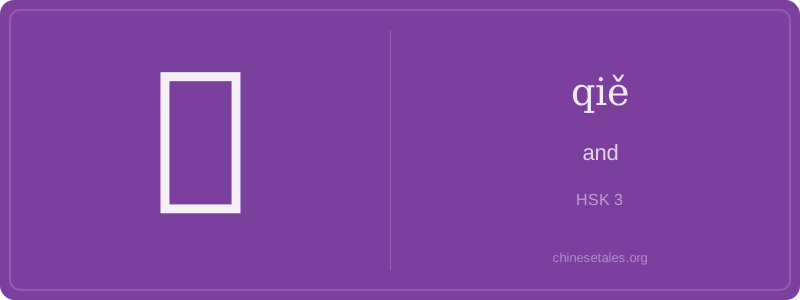
Carved onto oracle bones over 3,000 years ago, 且 began as a pictograph of a sacred ancestral altar — a raised platform (the top horizontal stroke) supporting ritual offerings, with vertical lines representing supporting posts or bundled sacrificial bundles. The earliest forms show three vertical strokes beneath one long horizontal line — unmistakably architectural and ceremonial. Over centuries, the three posts simplified into two, then one central stroke, while the top bar remained dominant; by the seal script era, it had settled into the clean, balanced shape we know: a single horizontal line (radical 一) above a curved, descending stroke that evolved from a ritual post into today’s distinctive 'leg-like' form.
This altar origin explains everything: altars were places of *addition* — offerings piled on offerings, generations layered upon ancestors, rituals accumulating meaning. So 且 naturally developed the sense of 'furthermore', 'in addition', and 'also' — not just arithmetic addition, but sacred accumulation. In the Classic of Poetry, 且 appears in lines like '且以喜乐,且以永日' ('Moreover, let us rejoice; moreover, let us lengthen the day'), where it layers blessings with liturgical weight. Even today, its visual simplicity — one line holding up meaning — echoes that ancient platform: minimal structure, maximal significance.
Think of 且 (qiě) as Chinese’s linguistic 'and-also-while-we’re-at-it' — less like the formal 'and' in English grammar and more like the breezy, multitasking 'and' you’d use while juggling coffee, keys, and your phone: 'I’ll call you back *and* check the train schedule *and* grab lunch.' In Chinese, 且 signals addition *with a twist*: it often introduces something unexpected, emphatic, or even slightly defiant — like adding 'besides!' or 'what’s more!' to your sentence. It’s not for simple listing ('apples and oranges'); that’s 的 and 与. Instead, 且 glues ideas with forward momentum.
Grammatically, 且 most commonly appears before verbs or adjectives in written or formal spoken Chinese, especially in compound structures like 且…且… ('both…and…') or 且…,…也… ('not only…but also…'). For example: 他且聪明且勤奋 — 'He is *both* smart *and* hardworking.' Notice how 且 wraps around each quality, giving equal weight and rhythmic punch. Learners often mistakenly place it after the subject like English 'and', but 且 *must* directly precede the element it modifies — no subject in between!
Culturally, 且 carries classical elegance — it’s frequent in proverbs, news headlines, and formal writing, lending gravitas. A common mistake? Using it in casual speech where 而且 or 还 is natural. Also, never confuse its tone: qiě (third tone), *not* qiē (first tone, 'to cut') or qū (first tone, 'bend'). Its brevity (just five strokes!) belies its rhetorical heft — like a tiny drumroll before a reveal.