久
Character Story & Explanation
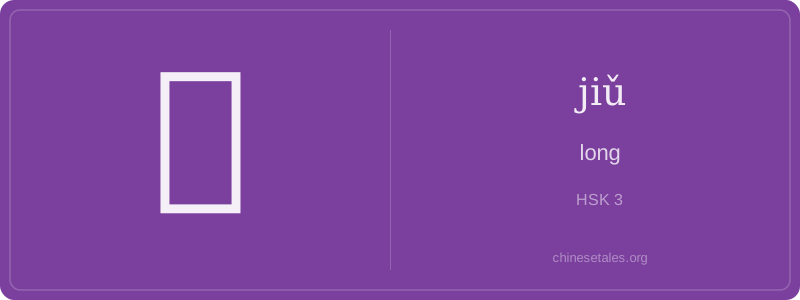
The earliest form of 久 appears in oracle bone inscriptions as a simple, elegant curve — not unlike a bent arm or a coiled serpent resting on its side. Scholars believe it was originally a pictograph of a *person kneeling with arms extended forward*, symbolizing waiting, endurance, or submission over time. Over centuries, the form simplified: the kneeling posture flattened into three decisive strokes — a descending slash (丿), a dot (丶), and a rising hook (乙) — merging into today’s minimalist 久. Its radical 丿 (pie) — the ‘left-falling stroke’ — hints at motion downward and outward, echoing the idea of time flowing and settling.
This visual reduction didn’t dilute its meaning — it intensified it. In the *Shuōwén Jiězì* (100 CE), Xu Shen defined 久 as ‘to rest for a long time’ (久,从后灸省声。久,息也), linking it to stillness and sustained presence. By the Tang dynasty, poets like Li Bai used it evocatively: ‘人生得意须尽欢,莫使金樽空对月’ — where the implied 久 behind ‘人生’ (rénshēng, human life) adds gravity. Its three-stroke simplicity masks profound cultural weight: in Chinese thought, true longevity isn’t just years lived — it’s time imbued with meaning, memory, and mutual care.
Imagine you’re sitting with your Chinese grandmother, sipping tea that’s been steeping for *jiǔ* — not just minutes, but long enough for the leaves to surrender their deepest flavor. That’s 久: it’s not about clock time, but about *felt duration* — a slow, weighty, almost physical stretch of time. It conveys endurance, persistence, and depth, like ‘a long friendship’ (长久的友谊) or ‘long-standing custom’ (久俗). Unlike English ‘long’, 久 rarely stands alone as an adjective; it’s most at home in compounds or adverbial phrases like 已经很久了 (yǐjīng hěn jiǔ le — ‘it’s been a long time already’).
Grammatically, 久 is almost never used before a noun like ‘long day’. You won’t say *久天* — that’s ungrammatical. Instead, it appears after verbs (e.g., 住久了 — zhù jiǔ le, ‘have lived there a long time’) or in fixed expressions (多久 — duō jiǔ, ‘how long?’). Learners often overuse it trying to translate ‘long’ literally — but native speakers reach for 长 (cháng) for physical length or duration in neutral contexts, and 久 only when emphasizing emotional weight or historical continuity.
Culturally, 久 carries quiet reverence — think of 久仰 (jiǔ yǎng, ‘long admired’, used when meeting someone respected for years) or 万寿无疆,福如东海,寿比南山 (wàn shòu wú jiāng, fú rú dōng hǎi, shòu bǐ nán shān — ‘may your life be endless, your fortune as vast as the East Sea, your longevity surpassing Mount Nan’). Mistake it for ‘old age’? No — that’s 老 (lǎo). Confuse it with ‘already’? That’s 已 (yǐ). 久 isn’t about completion — it’s about *continuation with dignity*.