乎
Character Story & Explanation
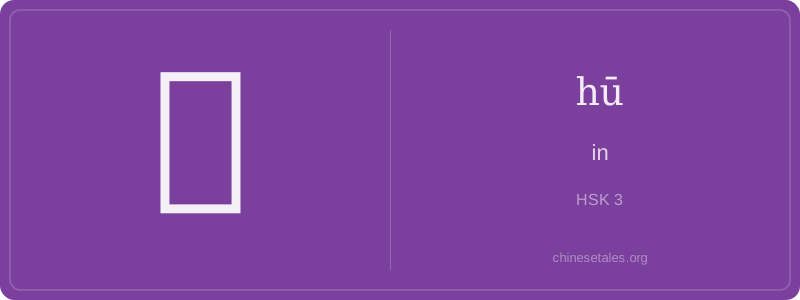
The earliest form of 乎 appears in Warring States bamboo texts — not as a pictograph of a thing, but as a phonetic-semantic compound. Its top part 丿 (piě) was originally a simplified variant of 于 (yú), while the bottom 乎 mimicked the shape of a mouth breathing out sound — suggesting vocalization, questioning, or exclamation. Over time, the upper element streamlined into the single falling stroke we see today, and the lower part stabilized into the three-dot-and-hook shape (the ‘mouth’ evolving into a stylized ‘breath’ glyph). Five strokes total — minimal, but charged with intention.
This visual economy mirrors its semantic journey: from early oracle bone inscriptions where similar glyphs marked ritual utterances, 乎 became the go-to particle for rhetorical questions in Confucian and Daoist classics. In the Analects, 学而时习之,不亦说乎? (‘Is it not delightful to study and practice regularly?’) — here, 乎 doesn’t ask for an answer; it invites shared affirmation. The character’s lightness — just five strokes — belies its weight in shaping Chinese philosophical dialogue: it turns statements into invitations, assertions into gentle provocations.
At first glance, 乎 (hū) looks like a tiny, breathy particle — and that’s exactly its vibe in Chinese: it’s not a concrete noun or verb, but a grammatical whisper that adds nuance, doubt, or rhetorical flair. It doesn’t mean 'in' as a preposition (that’s 在 zài); rather, it’s an archaic yet living interrogative or exclamatory marker — think of it as the classical Chinese equivalent of raising your eyebrows mid-sentence. You’ll encounter it mostly in fixed expressions, literary quotations, or formal writing — never in everyday ‘I’m ordering dumplings’ speech.
Grammatically, 乎 most often appears at the end of questions (e.g., …乎? meaning ‘…, right?’ or ‘…, isn’t it?’), or after adjectives/adverbs to form emphatic comparisons (e.g., 热乎乎 hū hū hū — ‘steaming hot!’). Crucially, it never stands alone: it clings to other words like a linguistic accent mark. Learners sometimes mistakenly use it like English ‘in’ or ‘at’, but 乎 has zero spatial meaning — confusing it with 在 or 里 is a classic HSK 3 trap.
Culturally, 乎 preserves the elegance and economy of classical Chinese thought: one stroke-light character doing heavy rhetorical lifting. Confucius used it over 200 times in the Analects — not to state facts, but to invite reflection. Modern learners feel its ‘old-school’ aura instantly: seeing 乎 signals ‘this sentence is quoting wisdom, sounding poetic, or gently teasing logic.’ Mispronouncing it as hù or omitting the tone mark (hū ≠ hu) also risks sounding like you’re gasping instead of questioning!