干
Character Story & Explanation
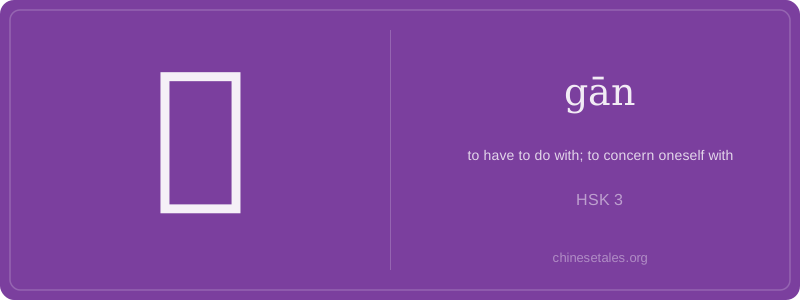
Oracle bone inscriptions show 干 as a stylized spear or lance — a single vertical line with two short horizontal slashes near the top, representing the shaft and crossbar of a weapon. Over centuries, the top 'blade' simplified into a short horizontal stroke, the middle became the long vertical, and the bottom evolved into another short horizontal — yielding today’s clean, minimalist 三-stroke form. Though it looks like 十 (ten) with an extra stroke, it’s not derived from it; the 十 radical here is coincidental — early bronze script forms clearly show the weapon’s profile, not arithmetic.
This martial origin explains its semantic leap: a spear isn’t just metal — it’s an instrument of *engagement*, of *intervention* in affairs. By the Warring States period, 干 had shifted from 'to attack with a spear' to 'to interfere in, to meddle in, to concern oneself with' — a natural extension of physical intrusion into social or political spheres. The Analects (15.20) uses it in the phrase 惟名与器,不可以假人,君之所司也;名以出信,器以出礼,礼信之干也 (Wéi míng yǔ qì, bù kě yǐ jiǎ rén… lǐ xìn zhī gān yě), where 干 means 'the pivot/essence upon which ritual and trust depend' — revealing how deeply its 'relational centrality' was already embedded in classical thought.
At first glance, 干 (gān) looks deceptively simple — just three strokes and the 十 (shí, 'ten') radical — but don’t be fooled: it’s a semantic chameleon with deep grammatical weight. Its core meaning isn’t about 'doing' or 'drying' (that’s the other pronunciation, gàn), but about *relational involvement*: 'to have to do with', 'to concern', 'to be relevant to'. Think of it as the Chinese equivalent of raising your hand in a meeting and saying, 'This point relates to what I said earlier.' It almost always appears in negative constructions like 不干…的事 (bù gān… de shì — 'has nothing to do with…') or in rhetorical questions like 这跟你有什么关系?(Zhè gēn nǐ yǒu shénme guānxi? — 'What does this have to do with you?').
Grammatically, 干 is nearly always paired with 跟 (gēn, 'with') or 在 (zài) in formal writing, and it’s rarely used alone — unlike verbs, it functions more like a relational preposition-verb hybrid. Learners often mistakenly treat it as an active verb ('I’ll handle it!'), but that’s gàn — a completely different word sharing the same character. Using gān where gàn belongs (or vice versa) turns 'I’ll take care of it' into 'This has nothing to do with me!' — a classic facepalm moment.
Culturally, 干 carries subtle social temperature: using 不关我的事 (bù guān wǒ de shì) can sound dismissive or even cold, while 关系到 (guān xì dào, 'to concern, affect') implies seriousness — e.g., 关系到生命安全 (guān xì dào shēngmìng ānquán, 'pertains to life safety'). Native speakers often soften it with particles like 啊 or 呢 in speech, but textbooks rarely mention that. And yes — it’s HSK 3, but its nuance trips up even advanced learners.