健
Character Story & Explanation
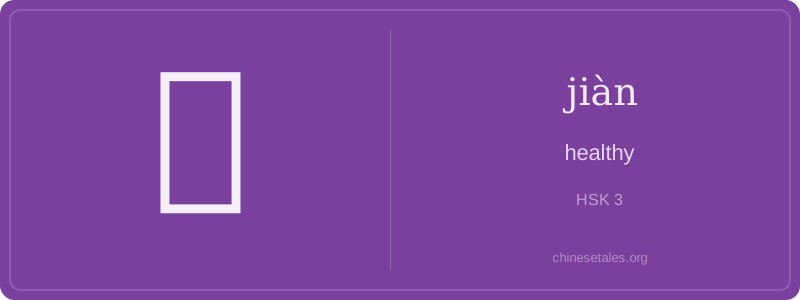
The earliest form of 健 appears in seal script, combining 亻 (a person) with 建 (jiàn, ‘to build, establish’). But 建 itself was originally a pictograph of a hand holding a drumstick over a drum — symbolizing command, initiation, and authoritative action. When fused with 亻, 健 emerged as ‘a person who initiates action with strength’ — not passive wellness, but *embodied agency*. Stroke by stroke, the modern form crystallized: the left-side 亻 (2 strokes) anchors the human element; the right side 建 (8 strokes) evolved from drum-and-hand into a stylized roof (宀) over ‘strength-in-motion’ (廴 + 凵 + 一), now read as a unified phonetic-semantic unit.
This visual logic shaped its meaning across millennia. In the *Zuo Zhuan*, ‘jian’ described warriors whose vigor enabled righteous action; in Tang poetry, it praised scholars whose mental stamina matched physical endurance. The character never meant mere biological function — it always implied *capable, sustained, purposeful energy*. Even today, 健身 isn’t just ‘body-building’; it’s cultivating the capacity to *act well in the world*. Its shape is a silent mantra: ‘A person, building strength — from within outward.’
At its heart, 健 (jiàn) isn’t just ‘healthy’ — it’s *robustly, actively, resiliently* healthy. Think less ‘no fever today’ and more ‘can hike a mountain after two hours of sleep’. In Classical Chinese, it carried connotations of strength, vigor, and moral fortitude — Confucius praised the ‘jian de’ (健德), the ‘vigorous virtue’ of a person who cultivates resilience through discipline. That energy still pulses in modern usage: it modifies nouns (健壮, 健康) and appears in verbs like 健身 (to exercise — literally ‘strengthen the body’), where it signals intentional, effortful cultivation of wellness.
Grammatically, 健 rarely stands alone as a predicate adjective (you wouldn’t say *‘Tā hěn jiàn’* — that’s unnatural). Instead, it partners: 健康 (jiànkāng, health), 健壮 (jiàn zhuàng, sturdy/strong), or forms verbs like 健忘 (jiàn wàng, ‘to forget easily’ — literally ‘healthily forget’, a delicious irony!). Learners often overgeneralize it like English ‘healthy’, but native speakers reach for 健 only when emphasizing *vitality*, *sturdiness*, or *functional soundness* — never for ‘organic food’ or ‘low-sugar yogurt’ (that’s 健康 food, not *健* food).
Culturally, 健 reflects China’s holistic view of wellness: not absence of disease, but dynamic balance and energetic readiness. You’ll see it everywhere — from fitness apps (健行, ‘healthy walking’) to corporate slogans (‘健力宝’, a sports drink brand whose name means ‘Healthy Strength Treasure’). A classic mistake? Writing 建 (jiàn, ‘to build’) instead — same sound, totally different meaning. Remember: if your character has a person (亻) and a ‘strong’ component (建), it’s about *human vitality*, not construction.