伞
Character Story & Explanation
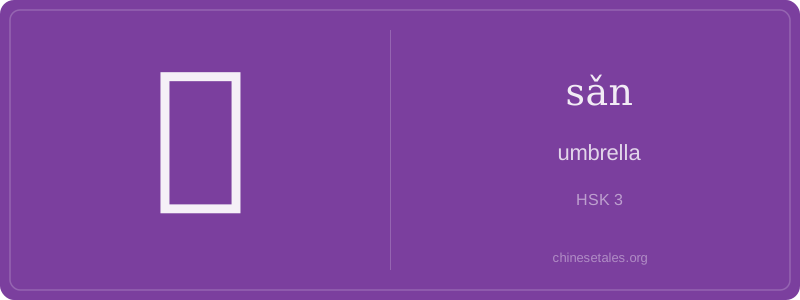
The earliest form of 伞 appears in Han dynasty clerical script, not oracle bones — because umbrellas were luxury items invented later. Its original pictograph was striking: a dot (•) representing the top knob, four slanting strokes radiating outward like ribs, and two vertical lines beneath mimicking supporting poles — all under a simple roof-like cover. Over centuries, the top evolved into the radical 人 (rén, ‘person’), stylized as two downward strokes (丿㇏), while the four ‘ribs’ condensed into the four dots (灬) below — giving us today’s 伞: a person-shaped frame holding up protective dots. It’s one of very few characters where the radical visually echoes its function: the ‘person’ radical isn’t semantic here — it’s structural scaffolding.
This character didn’t exist in early classical texts; umbrellas were rare before the Han. By the Tang dynasty, 伞 became status symbols — imperial processions used yellow silk 伞 with dragon motifs, strictly forbidden for commoners. The character’s stability across 2,000 years is remarkable: unlike many characters that shifted meaning, 伞 kept its core idea of ‘shelter from above’ so consistently that even modern loanwords (like ‘umbrella term’) borrow its logic — hence the compound 伞形结构 (sǎn xíng jiégòu, ‘umbrella-shaped structure’) in linguistics and engineering.
At first glance, 伞 (sǎn) feels like a straightforward 'umbrella' — but in Chinese, it’s more than rain gear: it’s a quiet symbol of shelter, care, and even social responsibility. You’ll hear parents say ‘我给你撑伞’ (wǒ gěi nǐ chēng sǎn) — literally ‘I hold the umbrella for you’ — which doubles as a tender idiom meaning ‘I’ll protect you’ or ‘I’ve got your back.’ Unlike English, where ‘umbrella’ is mostly literal, 伞 often appears in metaphors of protection: government policies are called ‘社会保障伞’ (social security umbrella), and tech companies build ‘数据安全伞’ (data security umbrella).
Grammatically, 伞 is a noun that rarely stands alone in speech — you’ll almost always see it with a measure word (e.g., 一把伞 yì bǎ sǎn) or a verb like 撑 (chēng, ‘to hold open’) or 打 (dǎ, colloquial for ‘to open/use’). Learners often omit the measure word or mispronounce the third tone — saying ‘san’ flat instead of ‘sǎn’ (like the ‘a’ in ‘father’ with a dipping tone). Also, don’t confuse it with verbs: 伞 itself never means ‘to umbrella’ — Chinese doesn’t verbify it like English does!
Culturally, umbrellas carry layered meanings: red ones are auspicious at weddings (warding off evil), while black ones appear in funerals — yet modern urbanites treat them purely functionally. A common mistake? Using 伞 to mean ‘parasol’ without context — but in Mandarin, parasols (for sun) and rain umbrellas share the same word, unlike Japanese (kasa vs. higasa). Context — not vocabulary — tells the difference.