像
Character Story & Explanation
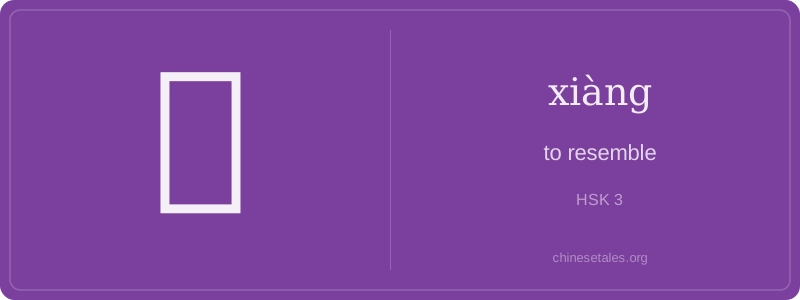
The earliest form of 像 appears in seal script as a person (亻) beside a stylized, upright figure with arms raised — likely representing a ritual effigy or ancestral image carved in wood or bronze. The right side evolved from 象 (xiàng, 'elephant'), not because elephants were involved, but because 'elephant' was borrowed phonetically (same sound!) while its rich, solid shape suggested 'form' or 'likeness'. Over centuries, the elephant’s trunk and legs simplified into the modern 口 + 丶 + ノ + 一 + 丿 + 丶 sequence — 13 strokes total, with the human radical 亻 anchoring its relational meaning: likeness requires a *person* doing the perceiving.
By the Han dynasty, 像 had crystallized into two core senses: noun (‘image’, ‘statue’) and verb (‘to resemble’). In the *Classic of Filial Piety*, elders are urged to 'keep ancestors’ images (像) in mind' — linking visual representation to moral memory. Later, in Tang poetry, poets used 像 to craft delicate similes ('Her smile like spring mist'), cementing its role in evoking emotional resonance through comparison. The character’s duality — human observer + embodied form — makes it uniquely Chinese: resemblance isn’t passive observation; it’s an act of recognition, reverence, and relationship.
Think of 像 (xiàng) as Chinese’s version of the word 'like' in English — but with superpowers. It doesn’t just mean 'resemble'; it’s the grammatical glue for comparisons, the backbone of similes, and even doubles as a noun meaning 'image' or 'statue'. Unlike English 'like', which can be casual ('She sings like an angel'), 像 always demands structure: subject + 像 + object (no 'as if' or subjunctive fluff). Say 'Tā xiàng yì zhī xiǎo māo' (He’s like a little cat) — and you’ve nailed both grammar and tone.
Grammatically, 像 is deceptively simple but easy to misuse. Learners often wrongly insert 是 before it ('Tā shì xiàng…') — a classic fossilized error. No! 像 stands alone: no 是, no 很, no adverbial padding. Also, it’s never used for identity ('He *is* a cat') — that’s 是; 像 only ever means 'resembles'. And crucially: when used as a noun ('a photo', 'a statue'), it’s pronounced the same but shifts register — think of it as the character wearing two hats: one for grammar, one for objects.
Culturally, 像 carries quiet reverence — from Buddhist statues (佛像 fó xiàng) to ancestral portraits (画像 huà xiàng), it implies something that *embodies* essence, not just appearance. That’s why saying 'Nǐ xiàng nǐ bàba' (You look like your dad) feels warmer and more holistic than 'You have his nose' — it hints at shared spirit, not just features. A common slip? Confusing it with 相 (also xiàng) — but that’s a different radical, different history, and far more abstract (e.g., 'mutual' or 'appearance' in philosophy).