家
Character Story & Explanation
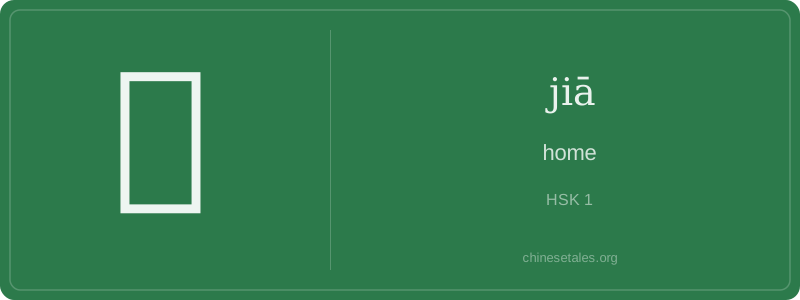
The earliest form of 家 appears on Shāng dynasty oracle bones (c. 1200 BCE) as a clear pictograph: a simple roof (宀) drawn over a stylized pig (豕), complete with snout, legs, and curly tail. Scribes carved it to represent a sheltered domestic compound—where humans and pigs coexisted symbiotically. Over centuries, the pig evolved: bronze script softened its curves; seal script standardized the strokes; and by the Han dynasty, 豕 had simplified into its modern 7-stroke form beneath the unchanging roof. Even today, those ten strokes whisper that original truth: home isn’t just walls—it’s warmth, sustenance, and shared breath under one covering.
This concrete origin gave rise to rich semantic expansion. In the *Analects*, Confucius uses 家 to denote moral responsibility: ‘齐家治国平天下’ (qí jiā zhì guó píng tiānxià)—‘Regulate the family, govern the state, bring peace to all under heaven.’ Here, 家 isn’t optional background—it’s the foundational training ground for virtue. Later, poets like Tao Yuanming wrote of ‘归家’ (guī jiā, ‘returning home’) not as geography but as spiritual return—to authenticity, simplicity, and self. The pig may be long gone from city apartments, but its legacy lives on: every time you say 我家, you’re invoking 3,200 years of embodied belonging.
At its heart, 家 (jiā) isn’t just ‘home’ as a physical building—it’s the emotional and social nucleus: where family gathers, meals are shared, and identity is rooted. The character itself is a masterclass in visual etymology: the radical 宀 (mián), meaning ‘roof’ or ‘covering’, sits atop 豕 (shǐ), an ancient form of ‘pig’. Yes—pig! In early agrarian China, a family’s wealth and security literally lived under the same roof as their livestock, so a house with a pig inside *was* home. That visceral, grounded sense still echoes today—you’ll hear people say 我家 (wǒ jiā, ‘my home’) to mean ‘my family’ or even ‘my place’.
Grammatically, 家 is deceptively flexible. It’s not just a noun—it forms possessive constructions (e.g., 妈妈的家, māma de jiā, ‘mom’s home’), appears in measure words (一家三口, yī jiā sān kǒu, ‘a family of three’), and even functions as a suffix for professions (作家, zuòjiā, ‘writer’—literally ‘one who makes home/works at writing’). Learners often over-translate it as ‘house’ and use it where English says ‘household’ or ‘family’—but 家 rarely means an empty building; it implies life, belonging, and relational warmth.
Culturally, 家 carries Confucian weight: it’s the smallest unit of social harmony, tied to filial piety and ancestral continuity. A common mistake? Using 家 when you mean ‘residence’ in formal contexts—like rental listings (where 房子 fángzi is more neutral). Also, don’t confuse 家 with 宅 (zhái, ‘mansion’ or ‘geeky stay-at-home’ slang)—the latter lacks the familial warmth and pig-powered authenticity!