电
Character Story & Explanation
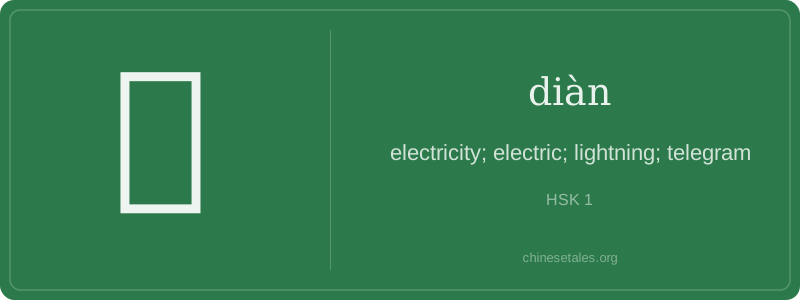
The earliest form of 电 appears on Warring States bamboo slips — not as lightning, but as a stylized depiction of lightning striking *downward* through clouds. Oracle bone inscriptions didn’t include it, but bronze script (金文) shows a vertical line (丨) representing the bolt, piercing a simplified cloud shape (the top part evolved into 曰). Over centuries, the cloud morphed into the radical 曰 (yuē, 'to speak'), while the central stroke sharpened into the lightning bolt — a brilliant visual pun: lightning doesn’t 'speak', but its flash is nature’s most dramatic utterance. By the Han dynasty, clerical script standardized the five-stroke form we use today: the top 曰 (4 strokes) plus one decisive downward stroke (丨) slicing through it — like electricity splitting the sky.
This visual logic shaped its meaning: lightning was the original 'electric' phenomenon — fast, luminous, uncontrollable. Classical texts like the *Huainanzi* (2nd c. BCE) describe 电 as the ‘yin-yang clash in heaven’ — the cosmic spark before thunder. As telegraphy arrived in late Qing China, 电 was repurposed for 'telegram' (diàn bào) because messages traveled at 'lightning speed'. Even today, the character retains that ancient urgency: when your phone dies, you don’t say 'battery empty' — you say 没电, echoing millennia of awe before the sky’s raw power.
At its heart, 电 (diàn) is the spark — not just the physics of electrons, but the visceral, awe-inspiring force of lightning that split ancient skies. Its core feeling is suddenness, power, and invisible energy: think crackling air before a storm, not silent wires. In modern usage, it’s the indispensable prefix for all things electric — from 电脑 (diàn nǎo, 'electric brain' = computer) to 电梯 (diàn tī, 'electric ladder' = elevator). Unlike English where 'electric' is an adjective, 电 in Chinese often functions as a noun modifier *without* 'de', making learners over-translate: you say 电话 (diàn huà, 'electric speech'), not *diàn de huà*.
Grammatically, 电 appears in three main patterns: (1) as the first element in compound nouns (e.g., 电视 — diàn shì, 'electric vision' = TV); (2) standalone as a noun meaning 'electricity' (e.g., 没电了 — méi diàn le, 'no electricity left'); and (3) in abbreviated forms like 电 (for 电话) in informal texts ('我给你发个电' — though rare, shows its lexical weight). A classic mistake? Using 电 to mean 'lightning' in everyday speech — while technically correct (e.g., 打雷闪电), native speakers prefer 闪电 (shǎn diàn) for 'lightning', reserving bare 电 almost exclusively for 'electricity' or 'telegraph' contexts.
Culturally, 电 carries historical resonance: in early 20th-century China, it symbolized modernity itself — electric lights in Shanghai dazzled a nation emerging from imperial twilight. Today, 'no electricity' (没电) jokingly describes low battery *and* human exhaustion ('我今天没电了!'), blending tech and idiom seamlessly. Learners also stumble by misplacing tones — diàn (4th tone, falling) is easily confused with diān (1st tone, flat high), which means 'to tip over' or 'summit'; context saves you, but muscle memory matters!