卡
Character Story & Explanation
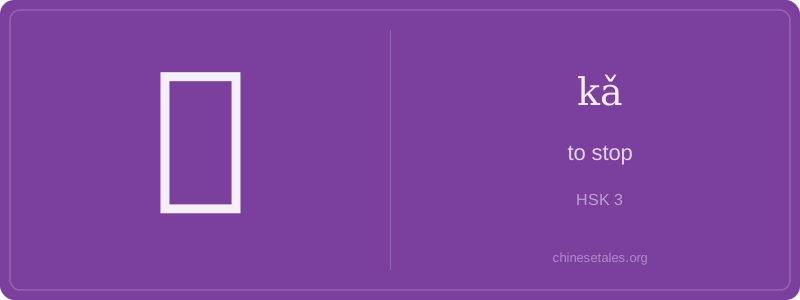
Oracle bone inscriptions show no direct ancestor of 卡 — it’s a relatively late creation, likely emerging during the Han dynasty as a simplified, phonetic-semantic compound. Its modern shape cleverly fuses two ideas: the top 十 (shí, ten) suggests ‘crossing’ or ‘intersection’, while the bottom 卜 (bǔ, divination crack) originally depicted cracks in turtle shells used for fortune-telling — symbolizing a break or fissure. Over time, 十 and 卜 merged into today’s compact five-stroke form: 一 (horizontal stroke), 丨 (vertical), 丿 (left-falling), 丶 (dot), and the final horizontal stroke at the bottom — visually echoing something wedged tight between two surfaces.
The meaning evolved from this image: a crack that *blocks* the flow of information or energy — just as diviners read fate through trapped lines in bone. By the Ming-Qing period, 卡 appeared in military texts meaning ‘to set up a barrier’ (e.g., 卡守 mountain passes), then broadened to any physical obstruction. Its modern sense of ‘to stall’ or ‘freeze’ emerged alongside railways and later electronics — a perfect semantic fit for anything that halts motion or data mid-transit. Interestingly, the character doesn’t appear in the Shuōwén Jiězì (121 CE), confirming its late arrival — a true linguistic child of China’s industrial age.
At its heart, 卡 (kǎ) is all about obstruction — that sudden, slightly frustrating halt when something gets stuck: a door jammed, traffic frozen, or your phone freezing mid-scroll. Unlike abstract verbs like 停 (to stop), 卡 feels physical and immediate — you can almost hear the ‘kǎ’ sound as a little verbal ‘clunk!’ It’s often used in result complements (e.g., 卡住) or as a verb on its own: ‘The elevator卡住了’ (The elevator got stuck). Notice it rarely stands alone without context — you’ll almost always see it with 把, 被, or in compound verbs.
Grammatically, 卡 is wonderfully versatile but sneaky: it’s not just for machines! You can 卡住 a person’s words (they’re tongue-tied), 卡在中间 (be stuck midway through a task), or even 卡时间 (time-manage tightly — e.g., ‘Don’t 卡时间 on small details!’). A classic mistake? Using 卡 where you need 停 — ‘The bus 卡了’ sounds like the bus jammed itself sideways; ‘The bus 停了’ means it simply stopped normally. Also, watch tone: kǎ (HSK 3 meaning) vs. qiǎ (as in 关卡 — checkpoint), which is more formal and literary.
Culturally, 卡 carries a subtle modernity — it entered wide usage only in the 20th century, booming with urbanization and tech. Older texts rarely use it; classical Chinese preferred 滞, 阻, or 塞. Today, it’s the go-to word for digital frustration: ‘Wi-Fi 卡’, ‘video 卡’, ‘app 卡死’. Learners sometimes overuse it trying to sound fluent — but native speakers reserve it for *unintended*, *mechanical*, or *emotional* stalling — never for polite pauses like ‘Let me think…’ (that’s 我想想).