参
Character Story & Explanation
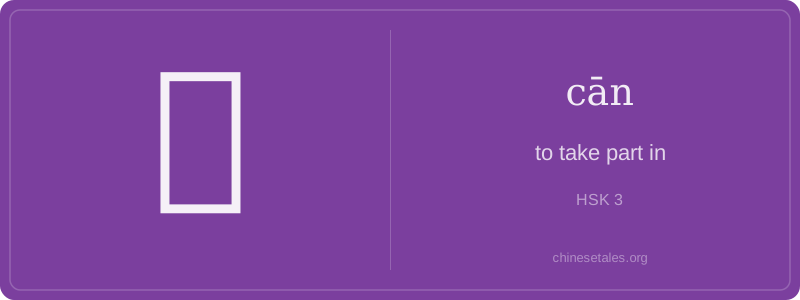
The earliest form of 参 appears in bronze inscriptions as a complex pictograph: three small circles (representing stars) above a kneeling figure with arms raised — an ancient astronomer observing the celestial triad known as the 'Three Stars' (Shēnxiù, later associated with Orion’s Belt). Over centuries, the star cluster simplified into the top component (厶 + 人-like strokes), while the kneeling figure evolved into the lower 厶 radical and the right-side stroke cluster. By the seal script era, it had stabilized into a structure hinting at 'person (人) entering a space (厶)', foreshadowing its participatory meaning.
This astronomical origin is key: early Chinese cosmology saw observing and aligning with celestial patterns as the highest form of participation — in cosmic order, ritual, and society. Confucius wrote in the *Analects* (12.1) that governing well requires 'participating in rites with reverence' (参与祭祀), linking 参 to active moral engagement. The character’s visual journey — from stargazer to citizen — mirrors how Chinese thought frames participation not as option, but as alignment: with heaven, with community, with meaning.
Think of 参 (cān) as the Chinese equivalent of 'signing up' — not just showing up, but actively stepping into a shared human rhythm, like joining a choir mid-song or raising your hand in a town hall. Its core meaning isn’t passive attendance ('I was there'), but intentional participation ('I chose to be part of this'). In English, we say 'attend a meeting'; in Chinese, you 参加 (cān jiā) it — literally 'enter and join', emphasizing volition and integration.
Grammatically, 参 almost never stands alone: it’s always paired — most commonly with 加 (jiā) in 参加, or with 与 (yǔ) in 参与 (cān yǔ), both meaning 'to take part in'. You’ll rarely see 参 without a partner character, unlike English verbs like 'participate' that work solo. A classic learner mistake? Using 参 by itself in speech ('I 参 the class') — it sounds as unnatural as saying 'I participate the class' in English. Always pair it!
Culturally, 参 carries quiet moral weight: classical texts like the *Analects* use it to describe engaging in ritual (礼 lǐ) or governance — participation as ethical duty, not convenience. That’s why 'not participating' (不参加 bù cānjiā) can subtly imply social withdrawal, not just absence. Also, watch the tone: shēn (as in 人参 rénshēn, 'ginseng') is a completely different word — same character, different history, zero semantic link. Don’t let the homograph distract you!