口
Character Story & Explanation
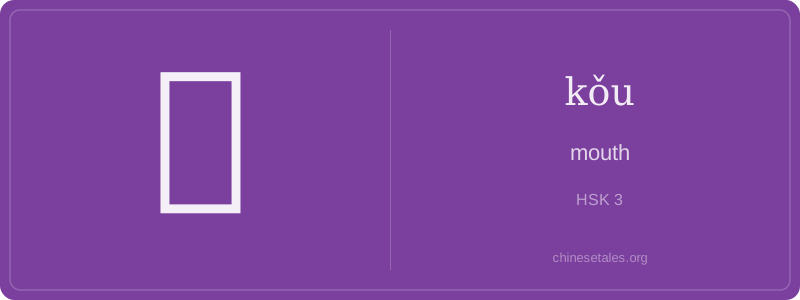
The earliest form of 口 appears on Shang dynasty oracle bones (c. 1200 BCE) as a simple, slightly irregular square — a stylized outline of an open mouth, sometimes with a dot inside representing the tongue or breath. Over centuries, the corners softened, the lines thickened in bronze script, and by the small seal script (Qin dynasty), it became a clean, symmetrical rectangle with three distinct strokes: left vertical, top horizontal, right vertical — no bottom stroke! This wasn’t an omission; it symbolized the mouth’s openness — the lower jaw isn’t sealed, it’s active, ready to speak or receive.
This visual logic persisted: the missing base reflects classical Chinese philosophy — the mouth is not a container but a conduit. In the Analects, Confucius warns, 'A gentleman is slow to speak and swift to act' (君子欲讷于言而敏于行), tying moral weight directly to 口. The character’s shape echoes that ideal: bounded yet open, disciplined yet expressive. Even today, when children learn 口, teachers emphasize drawing it without closing the bottom — a tiny physical reminder that wisdom begins with listening more than speaking.
At first glance, 口 is just 'mouth' — but in Chinese thought, it’s the gateway between inner and outer worlds. It’s where breath becomes speech, food becomes energy, and silence becomes intention. Unlike English, where 'mouth' is mostly anatomical, 口 carries weight: saying something 'from the mouth' (kǒu shàng) implies casualness or unreliability ('just talk'), while 'in the mouth' (kǒu lǐ) can mean 'on the tip of your tongue' — that frustrating near-recall. This character embodies Confucian awareness of speech as moral action: a slip of the 口 can damage trust, hence phrases like 口德 (kǒu dé, 'verbal virtue') — the ethics of what you say.
Grammatically, 口 is incredibly versatile. As a noun, it's straightforward: 他张开嘴 (tā zhāng kāi kǒu, 'He opens his mouth'). But it also functions as a measure word for things with openings or boundaries — a well (yī kǒu jǐng), a pot (yī kǒu guō), even a family unit (yī kǒu rén, 'one household', literally 'one mouth of people'). Learners often overgeneralize this and mistakenly use 口 for people (e.g., *sān kǒu rén* instead of *sān gè rén* for 'three people' — only *yī kǒu rén* works for 'a family of three').
Culturally, 口 appears everywhere — from 口号 (kǒu hào, 'slogan', literally 'mouth-call') to 口音 (kǒu yīn, 'accent', 'mouth-sound'). Its ubiquity reveals how deeply Chinese associates identity, belonging, and authenticity with vocalization. A common mistake? Forgetting that 口 never means 'oral' in medical contexts — that’s 口腔 (kǒu qiāng, 'oral cavity'); alone, 口 is visceral, social, and alive.