只
Character Story & Explanation
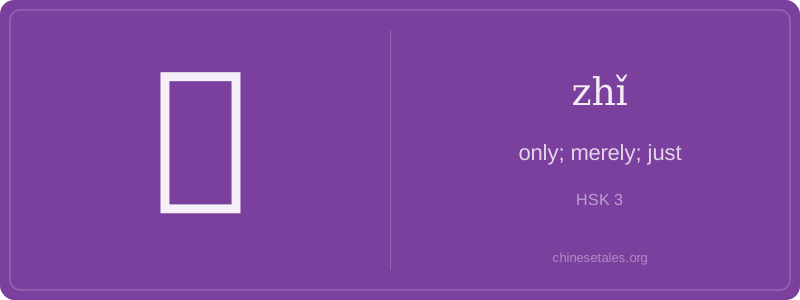
The earliest form of 只 appears in oracle bone inscriptions as a pictograph combining 口 (mouth, symbolizing speech or command) and a simplified glyph resembling a hand grasping or pointing — possibly indicating selection or singling out. Over time, the hand element stylized into the upper part (八 + 丨), while 口 remained intact at the bottom. By the seal script era, it had solidified into the five-stroke structure we know: a horizontal stroke, then two diverging strokes (like a 'V' or open hands), a vertical stroke cutting through, and the square mouth radical beneath — visually evoking 'one voice' or 'a single utterance' narrowing focus.
This ancient image of selective emphasis carried directly into classical usage: in the Analects, Confucius says '君子周而不比,小人比而不周' — and commentators used 只 to highlight exclusivity in interpretation ('只知其一,不知其二': 'knowing only one side, not the other'). Its grammatical role as an adverbial restrictor was already well established by the Han dynasty. The character’s compactness — just five strokes framing a mouth — subtly reinforces its function: a small shape delivering a big, limiting statement.
Think of 只 (zhǐ) as the Chinese equivalent of the English word 'just' — not in the sense of fairness, but that tiny, insistent particle that shrinks expectations: 'I *just* wanted coffee,' 'She’s *only* ten,' 'We have *merely* three minutes.' It’s the linguistic duct tape holding together modesty, limitation, and understatement — a cultural reflex deeply tied to Chinese values of humility and restraint. Unlike English ‘only,’ which can float freely, 只 almost always clings tightly to the word it modifies and must come *before* verbs, adjectives, or nouns it restricts.
Grammatically, it’s a strict gatekeeper: 只 + V / Adj / N, never after. Learners often mistakenly place it after the verb ('他吃饭只' — wrong!) or confuse it with the measure word for animals (zhī, also written 只). Remember: when meaning 'only,' it’s *always* zhǐ with the third tone — and if you hear someone say 'yī zhī niǎo' (a bird), that’s the *other* pronunciation (zhī), unrelated to restriction. Try this mental anchor: 'zhǐ = *zhee*-only' — the sharp, falling-rising tone mirrors how it *pins down* meaning like a thumb on a scale.
Culturally, 只 often softens statements to avoid sounding arrogant or absolute — '我只学了三个月汉语' ('I’ve *only* studied Chinese for three months') implies humility, not inadequacy. A common mistake? Using 只 when you mean 'already' (已经) or 'still' (还). And crucially: 只 cannot introduce exceptions (unlike English 'only' in 'Only John came'); for that, use 唯有 or 就…了. Mastering 只 is mastering the art of gentle precision.