啤
Character Story & Explanation
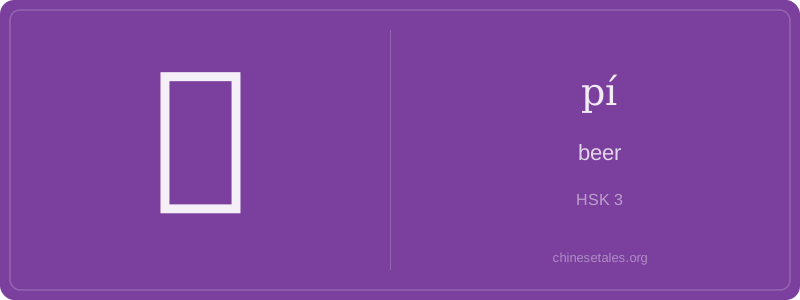
The character 啤 didn’t exist in oracle bone or bronze inscriptions — it’s a linguistic newcomer, first documented in late Qing dynasty texts around the 1870s. Its creation was deliberate and clever: take the existing character 皮 (pí, 'skin'), which already had the perfect pronunciation and a simple, stable structure, then replace its top component 丿+一 with 口 (kǒu, 'mouth') to signal ingestion. Visually, this transforms 'skin' into 'mouth-skin' — not literal, but a phonetic scaffold: 口 anchors meaning (something you put in your mouth), while 皮 provides the sound. The 11 strokes evolved cleanly — no archaic variants — because it was designed, not discovered.
This makes 啤 one of the earliest purpose-built transliteration characters in modern Chinese. Unlike classical characters shaped by millennia of use, 啤 was engineered like a linguistic app update: functional, efficient, and culturally neutral. It appears nowhere in pre-modern literature — no Confucian odes, no Tang poems toast it — but by the 1930s, it bubbled up in Shanghai advertisements and student magazines as Western-style leisure spread. Its visual simplicity — just 口 + 皮 — reflects its mission: be easy to write, easy to recognize, and unmistakably foreign yet fully domesticated.
Think of 啤 (pí) as Chinese’s phonetic 'brand name' for beer — like how 'Kodak' was invented to sound sharp and memorable, not to mean anything. It doesn’t carry ancient agricultural or philosophical weight; it’s a modern, onomatopoeic loan character created in the late 19th century to mimic the English word 'beer'. That’s why it feels so refreshingly un-Chinese: no hidden moral lesson, no classical poetry baggage — just crisp, frothy transliteration.
Grammatically, 啤 only appears in fixed compounds — you’ll never say *‘wǒ hē pí’* alone (that’s unnatural); instead, you say 啤酒 (pí jiǔ, 'beer') or order a 啤 (pí) in casual speech among friends — much like saying 'a Bud' in English. It’s always part of a noun phrase, never a verb or adjective, and never used without context (no standalone ‘pí’ in formal writing). Learners often mistakenly try to use it like a free-standing noun — but native speakers hear that as slangy, bar-counter shorthand, not textbook usage.
Culturally, 啤 is a quiet testament to China’s linguistic openness: it entered the language alongside bicycles, telephones, and Western medicine — all needing new words fast. Interestingly, older generations sometimes still call beer 汽水 (qì shuǐ, 'soda water') out of habit, while younger people may drop 啤酒 entirely and just say 啤 at a craft brewery. Watch out: don’t confuse it with characters that look similar — its 口 (mouth) radical signals it’s something ingested, not something written or seen.