嘴
Character Story & Explanation
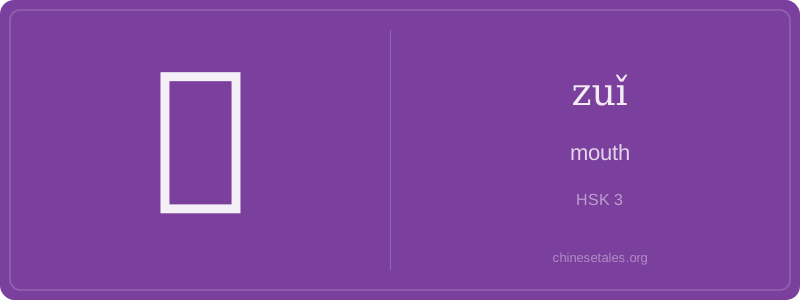
The earliest form of 嘴 isn’t found in oracle bones — it’s a later creation, born around the Warring States period as a semantic-phonetic compound. Its left side 口 (kǒu) is the unmistakable ‘mouth’ radical — a square with a dot inside, evoking lips framing an opening. The right side 是 (shì, ‘to be’) originally served as a phonetic hint (Old Chinese *s-təʔ* sounding close to *zuǐ*), but over centuries, 是 morphed visually: its top stroke flattened, the central ‘sun’ component simplified, and the bottom ‘foot’ turned into two quick dashes — yielding today’s 16-stroke silhouette that looks less like ‘to be’ and more like a mouth ‘being’ very busy.
This character didn’t exist in early classical texts — Confucius used 口 for ‘mouth’ in the Analects. 嘴 emerged later in vernacular literature like Ming dynasty novels, where realism demanded bodily specificity. In Water Margin, outlaws ‘clench their 嘴’ before battle — not just ‘close their mouths’, but seal their resolve with jaw tension. That shift from abstract 口 to embodied 嘴 mirrors Chinese literary history itself: from ritual precision to human grit.
At its heart, 嘴 (zuǐ) is the colloquial, flesh-and-bone 'mouth' — not the abstract or poetic one, but the lips, tongue, teeth, and vocal tract in action: the organ that eats dumplings, blurts secrets, tells jokes, and sometimes gets you into trouble. Unlike the more formal or literary 口 (kǒu), which appears in words like 口语 (spoken language) or 出口 (exit), 嘴 feels warm, physical, and slightly irreverent — think of a child stuffing food into their mouth or someone ‘shutting their嘴’ mid-argument.
Grammatically, 嘴 is almost always a noun and rarely used alone — it thrives in compounds (e.g., 嘴巴, 闭嘴) or vivid idioms. You’ll rarely say *‘my 嘴 is dry’*; instead, you’d say 我的嘴很干 (wǒ de zuǐ hěn gān), using the possessive 的 — a subtle but crucial HSK 3 grammar point learners often skip. Also, note: 嘴 is *not* used for ‘mouth’ in directional or spatial phrases (e.g., ‘the mouth of the river’ is 河口, not 河嘴) — that’s a classic trap!
Culturally, 嘴 carries expressive weight: ‘having a sharp嘴’ (嘴尖) implies wit or sarcasm; ‘a sweet嘴’ (嘴甜) describes flattery — not just taste, but social skill. And while 口 can be neutral or even bureaucratic (e.g., 口供 ‘confession’), 嘴 leans human, messy, and alive — it’s where gossip begins and noodles end.