园
Character Story & Explanation
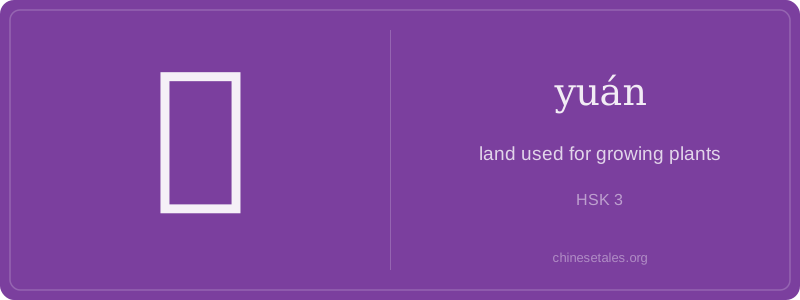
The earliest form of 园 appears in seal script as a square enclosure (囗) containing two simplified plant forms — originally drawn as sprouting seedlings or intertwined vines. Over centuries, the interior evolved: the bronze script showed three curling stems; the small seal script streamlined them into the modern ‘元’ — not as the word ‘yuan’ (origin), but as a phonetic-semantic compound where 囗 (wéi, ‘enclosure’) frames 元 (yuán, here serving primarily as sound clue, though its ‘first/primary’ meaning subtly reinforces the idea of a foundational cultivated space). By the Han dynasty, the seven-stroke structure stabilized: the outer 囗 (3 strokes) + inner 元 (4 strokes) — clean, balanced, and deeply intentional.
This visual logic mirrors classical usage: in the 4th-century text *Shì Shuō Xīn Yǔ*, ‘园’ appears in stories about literati retreating to private gardens for poetry and ink painting — spaces where nature was curated to mirror inner virtue. The enclosure wasn’t about exclusion, but about creating a microcosm where heaven, earth, and humanity met in miniature. Even today, the shape whispers: ‘What’s inside this boundary has been chosen, shaped, and honored.’
At its heart, 园 (yuán) isn’t just ‘garden’ — it’s a cultural container for harmony, cultivation, and human intention shaping nature. Unlike English ‘garden’, which often evokes casual backyard plots, 园 carries quiet dignity: it implies enclosure, care, and purposeful design — think scholar’s gardens in Suzhou or the imperial Yuanmingyuan. It feels cultivated, not wild; serene, not chaotic.
Grammatically, 园 is almost always a noun and rarely stands alone — you’ll nearly always see it in compounds like 花园 (huā yuán, flower garden) or 动物园 (dòng wù yuán, zoo). Crucially, it’s *not* used for ‘park’ in the Western sense (that’s 公园 gōng yuán); the ‘gong’ specifies public access. Learners sometimes mistakenly say ‘我去了园’ — but that sounds incomplete or poetic; native speakers say ‘我去公园了’ or ‘我去植物园了’. The character demands context — it’s a semantic anchor, not a freestanding word.
Culturally, 园 reflects the Chinese ideal of ‘taming nature with grace’: walls define space, paths guide contemplation, and every rock or pond is placed intentionally. This isn’t landscaping — it’s philosophy made visible. A common error is overgeneralizing 园 to mean any green space (e.g., calling a city square a ‘园’), but it implies active cultivation and aesthetic order — a vacant lot? No. A bonsai tray? Yes — if tended with ritual attention.