姨
Character Story & Explanation
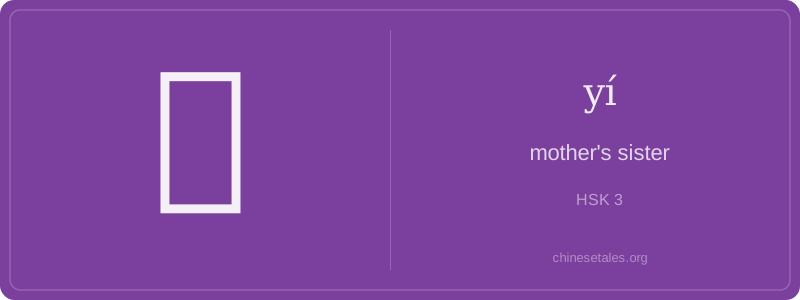
The earliest form of 姨 appears in bronze inscriptions around 1000 BCE, combining 女 (nǚ, 'woman') on the left with 夷 (yí, originally depicting a kneeling person with a bow and arrow, later simplified to '夷'). In oracle bone script, 夷 suggested 'eastern people' or 'peaceful submission' — but here, it served phonetically, lending the 'yí' sound. Over centuries, the right side evolved from a complex pictograph into today’s streamlined 夷: top stroke (一), then two parallel slants (丿丿), then the bottom '儿' — nine strokes total, all flowing with quiet authority.
By the Warring States period, 姨 solidified its meaning as 'mother’s sister' in texts like the Rites of Zhou, where kinship terminology was codified for ritual propriety. The choice of 女 + 夷 wasn’t arbitrary: 夷’s connotation of 'calm foreigner' may have subtly signaled the maternal aunt’s role as a gentle outsider within the patrilineal household — respected, yet distinct. Later, in Tang dynasty poetry and Ming fiction, 姨 often appeared in scenes of domestic intimacy, reinforcing her image as a confidante who bridged generations and households.
Think of 姨 (yí) as Chinese kinship’s version of 'Auntie' — but with precision a British genealogist would envy. Unlike English 'aunt', which lumps together mother’s sister, father’s sister, and even mother’s brother’s wife, 姨 refers *only* to your mother’s sister — no exceptions, no ambiguity. It’s not just familial labeling; it’s a linguistic GPS for maternal lineage, rooted in ancient clan structures where distinguishing maternal vs. paternal relatives carried real social weight.
Grammatically, 姨 behaves like any common noun: it takes measure words (一位姨, 两位姨), can be modified by adjectives (年轻的姨, 和蔼的姨), and appears in possessive constructions (我姨、她姨). Crucially, it’s never used alone as a form of address — you’d say 姨妈 or 姨姨 (depending on region), never just *‘Yí!’* — a classic HSK 3 trap. Learners often overgeneralize it to mean ‘any aunt’, leading to awkward moments when addressing their father’s sister (who is actually 伯母 or 姑妈).
Culturally, the character quietly reflects China’s historical matrilineal awareness — yes, Confucian patriarchy dominated, but kinship terms like 姨, 姑 (father’s sister), and 姐 (older sister) preserve nuanced distinctions that helped track inheritance, marriage alliances, and ritual obligations. Interestingly, 姨 is also used affectionately for older women unrelated by blood (e.g., a neighbor), but only after being invited to do so — using it uninvited can sound presumptuous or overly familiar.