婚
Character Story & Explanation
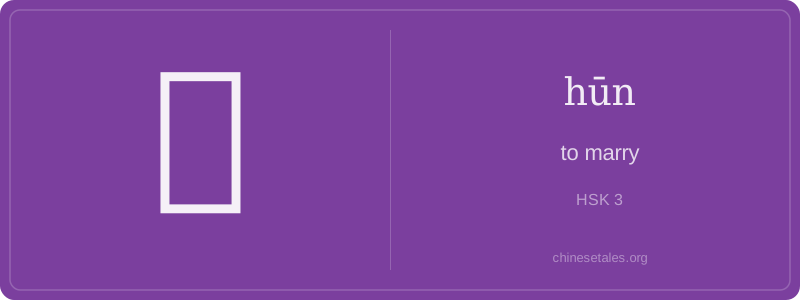
The earliest form of 婚 appears in bronze inscriptions around 900 BCE: a combination of 女 (woman) and 昏 (dusk/hūn), written as ⿰女昏. The ‘dusk’ component wasn’t arbitrary — ancient Zhou dynasty weddings were held at twilight, when the groom would travel to the bride’s home under cover of fading light, symbolizing transition and auspicious concealment. Over centuries, the top part of 昏 simplified from 日+氐 to the modern ⺈+氏 shape, while the 女 radical stayed firmly anchored on the left — visually anchoring the character’s association with women’s pivotal role in marital rites.
This dusk-rooted origin survived into classical texts: the Rites of Zhou explicitly states ‘娶妇以昏时’ (qǔ fù yǐ hūn shí, ‘a wife is taken at dusk’). Even as wedding timing shifted to daytime by the Tang dynasty, the character kept its name and form — a beautiful fossil of ritual memory. So every time you write 婚, you’re tracing a path lit by ancient twilight, where the stroke of the ‘dusk’ component still holds the soft glow of a thousand-year-old ceremony.
At its core, 婚 (hūn) isn’t just ‘to marry’ — it’s the formal, socially witnessed, ritualized act of entering marriage, carrying weight, commitment, and family continuity. Unlike English’s neutral ‘get married’, 婚 implies a transition: from single to spouse, from individual to kinship node. You’ll rarely hear it alone — it almost always appears in compounds like 结婚 (jié hūn, ‘to get married’) or 婚礼 (hūn lǐ, ‘wedding ceremony’). It’s not used for dating, engagement, or cohabitation — those are other words entirely.
Grammatically, 婚 is nearly always bound: you don’t say *‘wǒ hūn’ (I marry) — that sounds archaic or poetic. Instead, it pairs with verbs like 结 (jié, ‘to tie/complete’) or 离 (lí, ‘to part’) — 结婚, 离婚. Even the noun form 婚姻 (hūn yīn, ‘marriage’) is abstract and institutional, not personal. Learners often overuse 婚 as a standalone verb (like ‘I will hun next year’), but native speakers would instantly correct it to 我明年结婚.
Culturally, 婚 reflects how deeply marriage is embedded in Chinese social structure — not just romance, but lineage, duty, and ancestral responsibility. That’s why the character contains 女 (nǚ, ‘woman’) — historically, marriage marked a woman’s transfer from her natal family to her husband’s. Modern usage has softened this, but the radical remains a quiet echo of that legacy. A common mistake? Confusing 婚 with 昏 (hūn, ‘dusk’) — same sound, totally different meaning and origin!