季
Character Story & Explanation
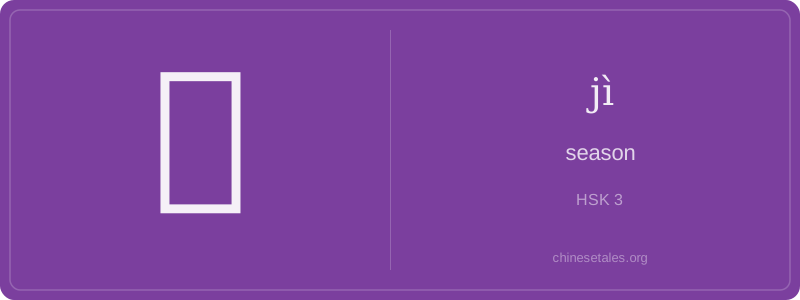
The earliest form of 季 appears on Shang dynasty oracle bones as a stylized depiction of a *child standing beneath a sprouting plant* — not just any child, but the *youngest son* (the semantic core of 子, 'child'), with three horizontal strokes above representing emerging shoots or seasonal growth. Over centuries, the top evolved from plant-like glyphs into the simplified 禾 (grain) radical in seal script, while the bottom solidified into 子. By the Han dynasty, the character had stabilized into today’s eight-stroke form: the top three strokes (禾’s head) + the crossbar + the flowing 子 below — a visual metaphor for youth, growth, and cyclical renewal.
This origin explains why 季 meant 'youngest son' in classical texts like the *Analects* (e.g., 季氏, the Jì clan — named after their youngest-line ancestor), before shifting to 'season' during the Warring States period. Why? Because just as the youngest son inherits the cycle of family succession, seasons represent nature’s recurring inheritance — spring inheriting winter, summer inheriting spring. The *Book of Rites* explicitly links 季 to the 'four divisions of heaven’s mandate', cementing its role as a cosmic rhythm marker, not just weather.
At its heart, 季 (jì) means 'season' — but not just any season: it’s the *rhythmic heartbeat* of Chinese timekeeping. Unlike English, where 'season' is a neutral noun, 季 carries agricultural gravity and cyclical elegance. It appears in fixed four-character phrases like 春夏秋冬 (chūn xià qiū dōng), but rarely stands alone as 'a season' — you’ll almost always see it paired: 春季 (spring season), 雨季 (rainy season), or in compound time words like 每季 (every season). Crucially, 季 never means 'quarter' in business contexts unless explicitly qualified (e.g., 第一季度); learners often overgeneralize and say *季度* when they mean *quarter*, forgetting that 季 by itself implies natural, climate-driven cycles — not fiscal calendars.
Grammatically, 季 is a noun that resists modification by measure words like 个; instead, it pairs with classifiers like 个 in compounds (一个季度) or stands bare in set terms (旺季, 淡季). You’ll also spot it in surnames (Jì family), adding a layer of personal resonance — making it one of the few HSK 3 characters that doubles as a common last name. And beware: while 季 sounds like jì, it’s *not* the same tone as 记 (jì, 'to record') or 寄 (jì, 'to mail') — mispronouncing it can turn 'autumn season' into 'autumn mail'!
Culturally, 季 ties deeply to the lunisolar calendar and imperial ritual — each season was governed by a different deity, color, and virtue. Modern usage preserves this solemnity: saying 今年雨季来得早 (This year’s rainy season came early) subtly echoes ancient flood-watch alerts. Learners often mistakenly use 季 for 'time period' broadly (e.g., *learning season*), but Chinese prefers 时期 or 阶段 — 季 is reserved for nature’s grand, predictable turns.