差
Character Story & Explanation
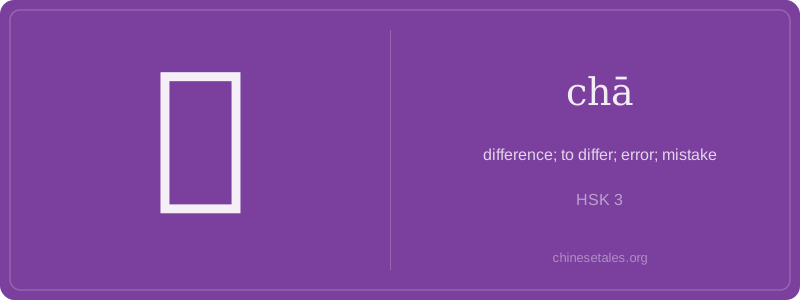
The earliest form of 差 appears on Western Zhou bronze inscriptions as a compound: a sheep head (羊) above a crosshatched 'work' symbol (工), later stylized. Scholars believe it originally depicted a *sheep’s horns branching asymmetrically* — nature’s first lesson in non-identical twins. Over centuries, the羊 simplified into three wavy strokes (巛), evoking divergence or ripples, while 工 remained steady below as the benchmark of uniformity. By the Han dynasty seal script, the structure solidified: top (巛) for 'unevenness', bottom (工) for 'standard' — together, they ask: 'How far does this deviate from the norm?'
This visual logic shaped its semantic journey. In the *Zuo Zhuan*, 差 describes ritual discrepancies ('the music was off by one note'); in Tang poetry, it measures emotional distance ('our hearts differ like north and south'). Even today, the shape whispers its origin: three flowing lines atop the square certainty of 工 — a perfect glyph for 'measured variation'. It’s no accident that 差 underpins words like 差距 (gap) and 差错 (error): both imply deviation from an expected, workmanlike standard.
At its core, 差 (chā) is about *variation* — not just 'difference' as a noun, but the active, often subtle, act of *differing*. Think of it as the Chinese word for 'not quite the same': two temperatures, two opinions, two versions of a story. The 工 radical (meaning 'work', 'craft', or 'standard') anchors it in human-made precision — like measuring tools or calibrated norms — while the top part (羊 minus one stroke? Actually, it’s a stylized variant of 羊 ‘sheep’ that evolved into 巛, representing divergence or flow) hints at branching paths or uneven terrain. This visual duality explains why 差 feels both technical (e.g., temperature difference) and relational (e.g., social gap).
Grammatically, 差 shines in comparative structures: 差很多 (chā hěn duō, 'differs greatly'), or as a verb in sentences like 这两个方案差得远 (zhè liǎng gè fāng àn chā de yuǎn, 'these two plans differ widely'). Crucially, it’s *not* used for simple 'is different from' — that’s 不同 (bù tóng). Learners often mistakenly say 我和他差很多 instead of 我和他很不同; 差 implies measurable disparity, not just categorical distinction.
Culturally, 差 carries quiet weight: in Confucian thought, recognizing 差 (e.g., age difference, rank difference) is foundational to proper conduct (lǐ 礼). A common mistake? Using chà (as in 差不多) when you mean chā — switching tones flips meaning from 'almost' to 'difference'. Also, don’t confuse it with the verb 'to send' (chāi), which shares the character but diverges historically — that usage comes from 'dispatching someone to bridge a gap'.