己
Character Story & Explanation
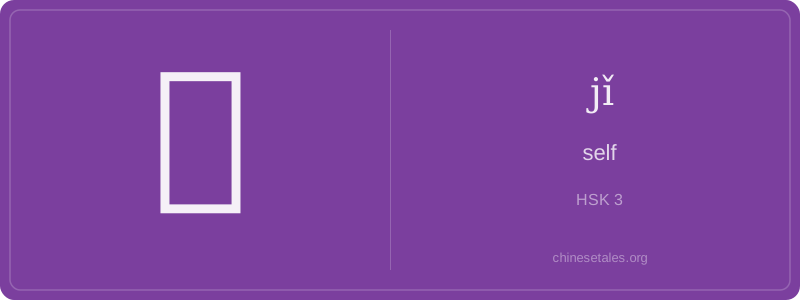
Carved over 3,000 years ago on oracle bones, the earliest 己 looked like a coiled serpent or a tightly wound rope — three gentle, curved strokes suggesting something closed, contained, and inward-turning. Scholars believe it depicted a knotted cord or a stylized human torso viewed from behind, arms folded — a visual metaphor for 'the self as bounded, centered, and whole'. Over centuries, the curves simplified: the top stroke became a smooth hook, the middle a soft crescent, and the bottom a sweeping, grounded curve — retaining that sense of enclosure without literal figuration. By the seal script era, it had stabilized into the elegant, symmetrical 3-stroke shape we write today.
This coil-to-self evolution wasn’t arbitrary. In ancient thought, 'self' wasn’t an open, expressive ego — it was a disciplined, circumscribed entity requiring cultivation. The Analects (12.1) urges '一日克己复礼,天下归仁焉' ('If for one day you restrain yourself and return to ritual, the world will ascribe benevolence to you'). Even the character’s radical is itself — 己 is its own radical, a rare case of a character housing its semantic core within its own form. Its visual closure mirrors its philosophical function: the self as both origin and boundary of moral action.
At its heart, 己 (jǐ) is the quiet anchor of Chinese selfhood — not flashy like 我 (wǒ, 'I'), but deeply reflexive and introspective. It’s the 'self' in 'by oneself', 'for oneself', or 'in one’s own way'. Think of it as the inner compass: unspoken, implicit, yet essential for expressing autonomy, effort, or perspective. Unlike English pronouns, 己 rarely stands alone; it clings to other characters like a suffix or appears in set phrases — you’ll almost never say *just* '己' in speech.
Grammatically, 己 shines in compound pronouns and reflexive constructions. Add it to 他 (tā, 'he') → 他自己 (tā zìjǐ, 'he himself'); pair it with 自 (zì, 'self') → 自己 (zìjǐ, 'oneself') — the most common word for 'myself/yourself/himself/etc.' at HSK 3. Notice: 自己 always refers back to the subject — no separate possessive form needed! Learners often overuse 我自己 ('wǒ zìjǐ') when context already implies 'I', or mistakenly treat 己 as a standalone noun ('I am 己?'). Nope — it’s a bound morpheme, like the '-self' in English, not a free word.
Culturally, 己 carries Confucian weight: in the Analects, '克己复礼' (kè jǐ fù lǐ) means 'restrain the self and return to ritual propriety' — self-cultivation as ethical duty. Also watch out for homophone traps: 己 (jǐ) sounds identical to 已 (yǐ, 'already') and 以 (yǐ, 'with/by'), but visually they’re worlds apart. Miswriting 己 as 已 in a sentence like 他自己 can turn 'he himself' into 'he already' — a tiny stroke, massive meaning shift!