张
Character Story & Explanation
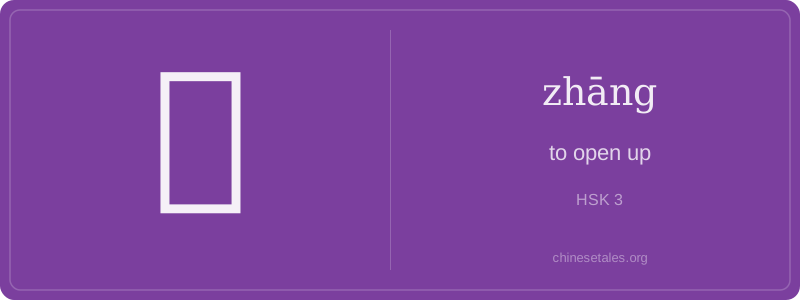
The earliest form of 张 appears in bronze inscriptions as a composite pictograph: a bow (弓) drawn taut, with an arrow nocked and ready — the string pulled back, the wood bent outward. That tension — the physical act of drawing a bow — was captured in strokes: the left-side 弓 radical, and on the right, a simplified version of 长 (cháng), which originally depicted a person with flowing hair and extended limbs — suggesting lengthening, stretching, extension. Over centuries, the right-hand component condensed into today’s 长, retaining its sense of elongation.
This archery origin directly seeded its semantic evolution: from the literal 'drawing a bow' in oracle bone texts (e.g., 'The king 张 his bow at dawn'), to classical usage meaning 'to deploy', 'to spread out', or 'to expand influence'. In the Book of Rites, 张 describes setting up ceremonial banners — not just hanging them, but *unfurling* them fully to signify presence and authority. Even today, the character visually echoes that ancient image: 弓 (the curved frame) holding 长 (the stretched line) — a perfect marriage of form and meaning.
Think of 张 (zhāng) as the gentle, purposeful act of unfolding — like opening a scroll, spreading a net, or widening your eyes in surprise. It’s not explosive or violent; it’s controlled expansion: stretching, unfolding, or deploying something that was previously compact or closed. This core idea of 'opening up' gives it warmth and intentionality — you don’t just ‘open’ a door with 张; you *unfurl* a banner, *spread* a map, or *widen* your gaze to take in more.
Grammatically, 张 shines as a verb (e.g., 张开 zhāngkāi — 'to open wide') and as a measure word for flat, thin, or sheet-like things — yes, even for mouths! You say 一张嘴 (yī zhāng zuǐ) — literally 'one sheet-mouth' — because a mouth opens like a flap or surface. Learners often mistakenly use 个 instead of 张 for photos (a photo is 一张照片, never 一个照片), or forget that 张 can be the main verb in commands: 别张着嘴!(Bié zhāng zhe zuǐ! — 'Don’t keep your mouth open!').
Culturally, 张 carries quiet authority: ancient generals ‘deployed troops’ (张兵 zhāng bīng), poets ‘unfurled sorrow’ (张愁), and today we still ‘open’ opportunities (张开怀抱 zhāngkāi huáibào — 'open one’s arms' metaphorically). A common slip? Confusing it with 章 (also zhāng, but meaning 'chapter' or 'seal') — different radical, different world. Remember: 弓 (bow) + 长 (long) = the bow stretched long → opening up.