复
Character Story & Explanation
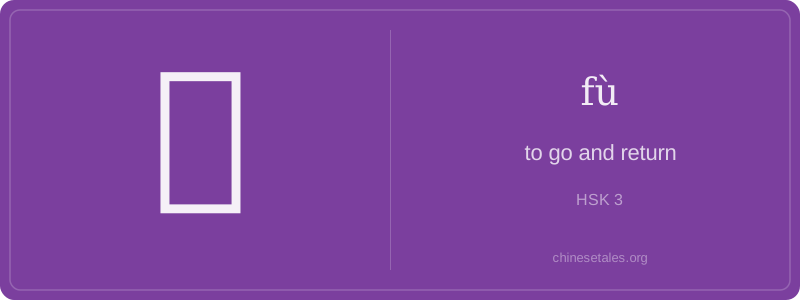
The earliest form of 复 appears in Western Zhou bronze inscriptions as a pictograph showing a foot (止) stepping *backwards* over a cave-like enclosure (宀), with a horizontal line underneath symbolizing ground. The radical 夊 (suī) — now at the bottom — originally represented a foot turning and retreating. Over centuries, the upper part simplified from 宀+彳+一 into the modern ‘日’-looking top (actually a stylized ‘夂’ + ‘一’), while the foot radical anchored the meaning of reversal and return. By the Han dynasty, the character had settled into its current 9-stroke shape — every stroke tracing a path turned back on itself.
This visual logic shaped its semantic journey: from literal 'stepping back into the dwelling' (early oracle bone usage) to 'returning to a former condition' (Zuo Zhuan: '复其社稷', 'restore their ancestral altars'). In the Analects, Confucius uses 复 in the phrase '克己复礼' — 'overcome self and *return* to ritual propriety' — cementing its philosophical weight as moral re-alignment, not mere physical motion. Even today, the character’s downward-sweeping 夊 radical feels like a foot planting firmly to pivot — a tiny graphic reminder that return is an act of will.
At its heart, 复 (fù) is about movement with intention — not just 'returning', but returning *to a prior state or place* after a deliberate departure. It carries quiet weight: in classical Chinese, it evoked ritual reenactment (like repeating rites to honor ancestors); today, it still suggests purposeful recurrence — think 'reviewing notes' (复习), 'repeating a phrase' (复述), or 'restoring order' (恢复). Unlike the casual 'come back' of 回 (huí), 复 implies structure, duty, or consequence.
Grammatically, 复 is rarely used alone in modern speech — it thrives as a bound morpheme in compound verbs and nouns. You’ll almost never say 'I fù' — instead, you say 我复习 (wǒ fùxí, 'I review') or 重复 (chóngfù, 'to repeat'). Crucially, it’s *not* the go-to word for 'reply' (that’s 回复 huìfù, where 复 adds the nuance of 're-' — i.e., responding *in kind*, completing a communication loop). Learners often overuse it trying to say 'return home', but that’s 回家 (huí jiā), not *复家* — a classic fossilized error.
Culturally, 复 reflects a deep Chinese value: cyclical integrity. Things don’t just happen once — they must be reaffirmed, repeated, restored. This shows up everywhere: from the Confucian ideal of 'revering the past to guide the present' (复古 fùgǔ) to the meticulous repetition in calligraphy practice. Mistake 复 for 回, and you lose that layer of solemn recurrence — it’s the difference between 'I came back' and 'I have recommitted to the path.'