必
Character Story & Explanation
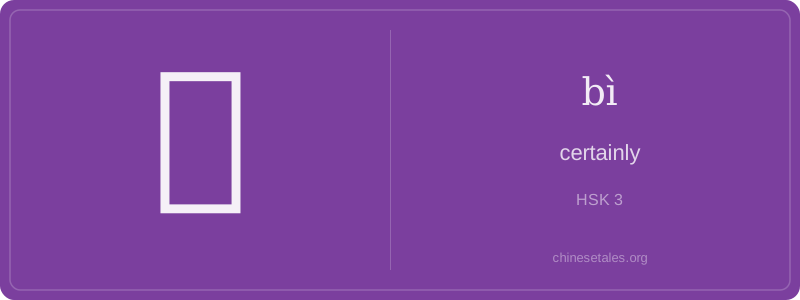
The earliest form of 必 appears on Western Zhou bronze inscriptions as a stylized 'arrowhead inside a container' — not heart-shaped at all! Oracle bone script shows three parallel strokes (like arrow feathers) above a horizontal line (a bow or target), suggesting 'hitting the mark without fail'. Over centuries, the top evolved into the modern 丿一丶 (a slash, horizontal, dot), while the bottom fused with the heart radical 心 — not because it's emotional, but because 心 was repurposed as a semantic marker for *internal necessity*, aligning with how ancient Chinese linked will, fate, and inner conviction.
This visual shift mirrors its semantic journey: from 'hitting the target' → 'guaranteed outcome' → 'inescapable truth'. By the Warring States period, philosophers like Mencius used 必 to express moral inevitability ('仁者爱人,爱人者必为人爱'). The heart radical wasn’t added for sentiment — it signaled that certainty arises not from external force, but from inner alignment with Dao or virtue. So 必 isn’t just 'sure'; it’s 'sure *in your bones*.'
Think of 必 (bì) as Chinese’s version of the exclamation point with a legal contract attached — it doesn’t just suggest certainty, it *demands* it. In English, we say 'probably' or 'likely'; in Chinese, 必 conveys something non-negotiable: 'this *must* happen', 'it is *inevitable*', 'there is *no alternative*'. It’s not polite hedging — it’s the linguistic equivalent of slamming a gavel.
Grammatically, 必 almost always appears before a verb or adjective, often paired with 要, 须, or 会 to strengthen necessity (e.g., 必须 — 'must'), or used alone in formal writing and classical-style expressions (e.g., 必胜 — 'certain victory'). Learners often mistakenly place it after the verb ('他成功必') — but no: 必 is a pre-verbal adverb, like 'definitely' in 'He will definitely succeed', never 'He succeeds definitely'.
Culturally, 必 carries subtle weight — it appears in slogans (团结必胜), exam instructions (考生必带证件), and Confucian texts implying moral inevitability ('德者,必得其禄'). A common pitfall? Overusing it in speech: native speakers prefer 一定 or 得 in casual talk; 必 feels stately, even bureaucratic. Using 必 in a text to your friend saying 'You *certainly* need to come!' sounds like a government memo — charmingly intense, but socially off-key.