忘
Character Story & Explanation
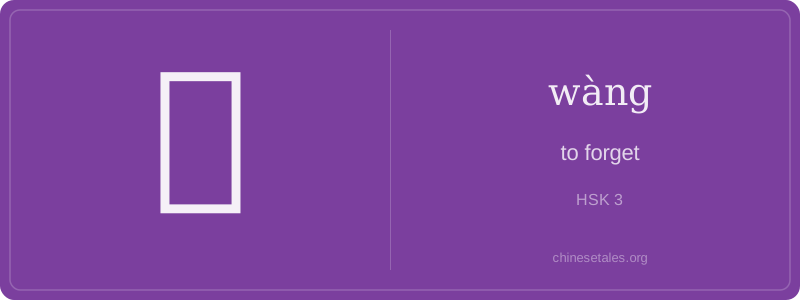
The earliest form of 忘 appears in bronze inscriptions around 1000 BCE — not as a picture of memory, but as a hand (爫, later simplified) hovering over a heart (心), suggesting deliberate release. Over centuries, the top evolved from 王 (a stylized hand holding a staff, symbolizing authority over mental states) into the modern 亡 — which looks like ‘lost’, but originally conveyed ‘to depart, to cease’. So 忘 literally means ‘the heart lets something depart’ — a beautifully embodied metaphor, not abstract cognition.
By the Han dynasty, 忘 appears in classics like the *Zhuangzi*, where ‘wàng wǒ’ (forgetting the self) describes transcendent harmony with nature. The visual link between 亡 (wáng, ‘to perish’) and 忘 (wàng, ‘to forget’) isn’t coincidence — both imply cessation, but 忘 adds the heart radical to stress *emotional* or *voluntary* release. This nuance persists: when someone says ‘wǒ wàng le’, they’re not reporting a glitch — they’re confessing a quiet, heart-led letting-go.
Imagine you’re at a Beijing teahouse, nervously reciting your first Chinese poem for your teacher. Halfway through, your mind blanks — not because you don’t know it, but because *your heart just let go of it*. That’s 忘 (wàng): not passive ‘not remembering’, but an active, almost willful release — like the heart (心) deliberately setting a memory free. It carries emotional weight: forgetting isn’t failure here; it’s sometimes relief, sometimes regret, always intimate.
Grammatically, 忘 is a transitive verb — it *takes* an object (what you forget), and often appears in patterns like 忘了 + noun/verb (‘forgot [something]’) or 忘不了 (‘can’t forget’). Watch out: learners often say *wàng le* without specifying *what* was forgotten — but Chinese requires it! You’d say ‘wǒ wàng le tā de míngzi’ (I forgot his name), never just ‘wǒ wàng le’. Also, 忘 never stands alone as a command — you wouldn’t shout ‘Forget!’; you’d say ‘bié wàng!’ (Don’t forget!) — because 忘 implies loss, not instruction.
Culturally, 忘 is quietly profound: Confucius praised ‘shì wàng’ (to forget grievances), and Daoist texts celebrate ‘wàng wǒ’ (forgetting the self) as spiritual freedom. Learners sometimes confuse it with passive verbs like ‘bù jìde’ (don’t remember), but 忘 suggests agency — *you* released it. And yes — it’s ironic that this character, meaning ‘to forget’, is one of the most unforgettable in HSK 3 thanks to its clean, heart-centered shape.