历
Character Story & Explanation
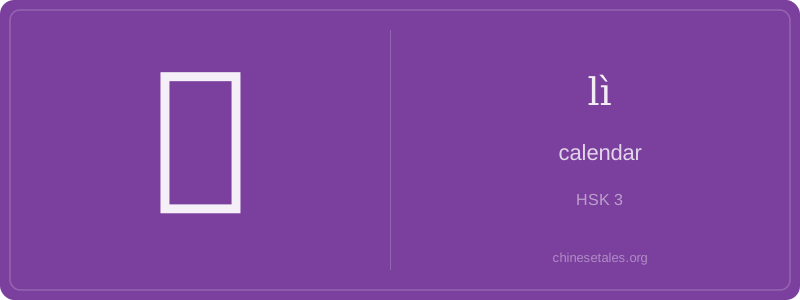
The earliest form of 历 (found in oracle bone inscriptions) looked like a simplified pictograph of a *mountain pass with a path winding through it* — written as a horizontal stroke over two diagonal lines converging downward (resembling 厂 + 丶丿). This wasn’t about geography: ancient Chinese astronomers observed the sun’s movement *through seasonal 'gates' in the sky*, like passing through mountain passes. The character evolved into bronze script as 厤, then clerical script streamlined it to today’s 历 — four crisp strokes: the radical 厂 (a shelter or overhanging cliff, suggesting a defined boundary or frame) plus the phonetic/semantic component 力 (lì, ‘force’ or ‘effort’), hinting at the *deliberate, systematic effort* required to track celestial cycles.
By the Han dynasty, 历 was firmly tied to calendrical science — texts like the Great Beginning Calendar (太初历 Tàichū Lì) standardized lunar-solar reckoning. Confucian scholars saw accurate calendrics as moral duty: a broken calendar meant cosmic disorder. Even today, the word 历法 (lìfǎ) echoes this gravity — it’s not ‘calendar-making’ as hobby, but ‘the method of ordering time’. Visually, the bare-bones structure of 历 — just 厂 + 力 — mirrors its function: a simple frame (厂) containing measured force (力) to chart time’s passage.
At its heart, 历 (lì) is about *measuring time* — not just ticking seconds, but the structured, authoritative tracking of days, months, and years. Think of it as the Chinese character for 'calendar' in the sense of an official, shared system: the lunar calendar, the Gregorian calendar used in China, or even a historical timeline. It’s not the abstract idea of time (that’s 时 shí), nor personal experience of time (like 经历 jīnglì — which actually *contains* 历!). Rather, 历 carries weight — it implies order, authority, and collective agreement on when things happen.
Grammatically, 历 most often appears in compound nouns (e.g., 日历 rìlì ‘desk calendar’, 历法 lìfǎ ‘calendar system’) or as part of verbs like 历史 (lìshǐ ‘history’ — literally ‘time-record’). Crucially, it almost never stands alone in modern speech — you won’t say *‘I check the lì’*; you say *‘I check the rìlì’*. Learners sometimes mistakenly use it where 经历 (jīnglì, ‘experience’) fits — but while 历史 means ‘history’ (recorded past), 经历 means ‘personal experience’ — same root, different emphasis and pronunciation (jīng vs. lì).
Culturally, 历 reflects China’s deep tradition of state-issued calendars: for millennia, emperors issued the official calendar (历法), symbolizing their mandate to harmonize heaven and earth. Mistaking 历 for similar-looking characters (like 厉 or 厂) is common — but remember: 历’s four strokes are clean, minimal, and purposeful — like a ruler marking off days. Its simplicity hides centuries of astronomical precision and imperial ritual.