更
Character Story & Explanation
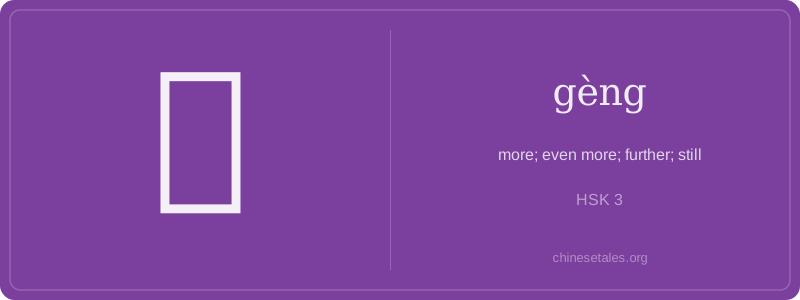
The earliest form of 更 (in oracle bone script, c. 1200 BCE) looked nothing like today’s character — it combined 曰 (yuē, ‘to speak’, later evolving into ‘say’/‘day’) with 攴 (pū, a hand holding a striking tool), suggesting ‘to strike anew’ or ‘to change by force’. Over centuries, the striking hand simplified into 冓 (gōu, ‘to meet’ or ‘interlock’), and the ‘say/day’ component shifted visually to 曰 — though scholars now agree the radical reflects sound, not meaning. By the small seal script (Qin dynasty), it stabilized into seven strokes: two horizontal lines framing a central ‘mouth-like’ 曰, topped by a slanted stroke and crossed by a final horizontal — a compact emblem of transition.
This visual evolution mirrors its semantic journey: from ‘to change (a watch, a ruler, a season)’ in ancient texts — like the Book of Documents’ ‘三更’ (sān gēng, ‘third watch of the night’) — to ‘further’, ‘still’, and finally the grammatical intensifier we use today. The radical 曰 may seem misleading (it doesn’t mean ‘say’ here), but its presence subtly echoes timekeeping: ancient China divided nights into five watches (gēng), announced aloud — so 更 literally meant ‘the next announced shift’, embedding rhythm, change, and progression into its very bones.
At its heart, 更 isn’t just a bland ‘more’ — it’s the Chinese language’s subtle intensifier, carrying quiet insistence and layered comparison. Think of it as the raised eyebrow before a stronger claim: not merely ‘big’, but ‘even bigger’; not just ‘good’, but ‘better still’. Unlike English adverbs that pile on syllables (‘more importantly’, ‘even more surprisingly’), 更 does heavy lifting in one compact syllable — reflecting a cultural preference for economical precision and contextual nuance over explicit redundancy.
Grammatically, 更 almost always appears before adjectives or verbs to signal comparative escalation — never alone. You’ll hear it in structures like 更 + adjective (e.g., 更高 gèng gāo, ‘taller’) or 更 + verb (e.g., 更喜欢 gèng xǐhuān, ‘like even more’). Crucially, it *requires* an implied or stated point of reference: saying ‘他更高’ only makes sense if we already know *who* he’s taller than — context is king. Learners often mistakenly use 更 where they need 最 (zuì) for superlatives, or confuse it with 又 (yòu) for repetition — a tiny slip that turns ‘She’s even kinder now’ into ‘She’s kind again’.
Culturally, 更 reveals how Chinese evaluates change incrementally, not absolutely — progress, emotion, or quality is measured *relative to what was*, not against an abstract ideal. In classical texts like the Analects, 更 appears in phrases like ‘更也,人皆仰之’ (‘When one improves, all look up to him’), underscoring moral growth as continuous refinement. That’s why native speakers rarely say ‘very good’ — they say ‘更好’ (‘even better’), honoring the journey, not the destination.