查
Character Story & Explanation
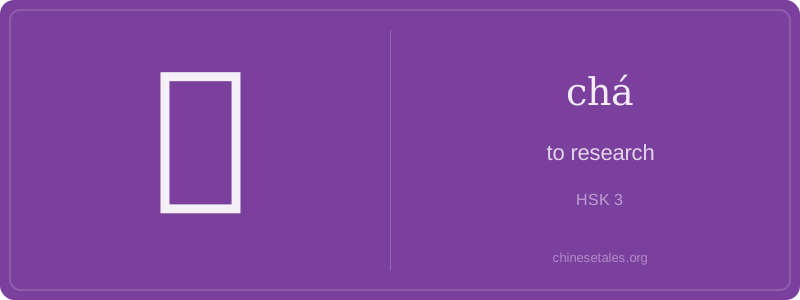
The earliest form of 查 appears in seal script (c. 3rd century BCE), where it clearly combines 木 (mù, 'tree') on the left and 察 (chá, 'to examine') on the right — but 察 itself evolved from an ancient pictograph showing an eye (目) beneath a roof (宀), symbolizing careful observation *within a space*. Over time, 察 was simplified into 查 by replacing the top roof-and-eye component with 曰 (yuē, 'to speak'), then further stylized. Crucially, the 木 radical wasn’t arbitrary: early uses linked ‘investigation’ to *wooden tally sticks* — official documents carved on bamboo or wood, which officials would literally ‘check’ against each other for authenticity.
This wooden-document origin explains why 查 became entrenched in administrative language: in the Han dynasty, clerks 查核 (cháhé, 'verified') tax records inscribed on wooden slips; by the Tang, 查 appeared in legal codes meaning 'to cross-check testimony.' The character’s visual logic is elegant: the 木 radical grounds it in tangible, physical record-keeping, while the right side hints at discernment. Even today, when you 查一个手机号, you’re echoing ancient scribes running their fingers down grooves in bamboo — seeking truth one mark at a time.
At its core, 查 (chá) is about active, methodical investigation — not passive looking, but deliberate searching: checking records, verifying facts, or inspecting details. Think of a librarian pulling files or a detective scanning evidence. It’s never casual; it implies purpose and procedure. Unlike 看 (kàn, 'to look') or 观察 (guānchá, 'to observe'), 查 always involves scrutiny with intent — you 查 information, 查资料, or 查证 a claim.
Grammatically, 查 is most often a verb in the V-O structure ('查 + object'), and frequently appears in compound verbs like 查找 (cházhǎo, 'to search for') or 查阅 (cháyuè, 'to consult'). At HSK 3, learners commonly use it with 了 (le) for completed action (我查了天气预报) or in imperative form (请查一下). A frequent mistake? Using 查 where 看 fits better — saying *我查这本书* instead of 我看了这本书 ('I read this book') — because 查 demands an object that’s *informational or verifiable*, not experiential.
Culturally, 查 carries subtle authority: it’s the verb used by officials (查户口, 'check household registration'), teachers (查作业), or platforms (查重, 'plagiarism check'). That’s why it feels formal — even bureaucratic. Interestingly, native speakers sometimes soften it with 小心地 or 仔细地 (e.g., 请仔细查一下), revealing how seriously they take accuracy. Also note: it rarely stands alone — you almost never say just '我查' without specifying *what* you’re checking.