梯
Character Story & Explanation
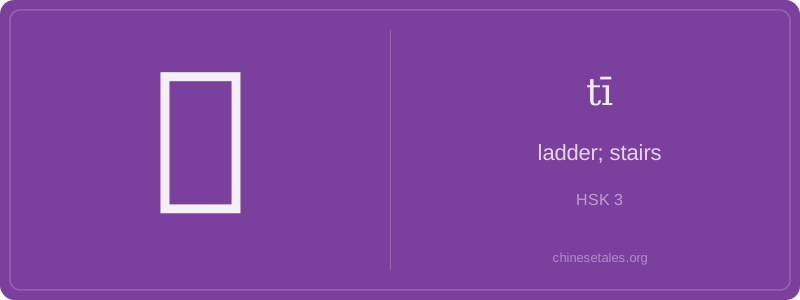
The earliest form of 梯 appears in bronze inscriptions as two parallel vertical lines (representing upright posts) crossed by three or four evenly spaced horizontal strokes — a perfect pictograph of a simple wooden ladder. Over centuries, the left side evolved into the 木 (mù, ‘tree/wood’) radical, anchoring its material essence, while the right side solidified into 弟 (dì, ‘younger brother’), not because of kinship, but due to phonetic borrowing: 弟 sounded close enough to the ancient pronunciation of ‘ladder’ (*tʰeːɡ) to serve as a phonetic component. The 11 strokes today precisely echo that ancient scaffold: two verticals (the side rails), four horizontals (rungs), plus the 木 radical’s four strokes — all adding up to structural clarity.
In the Shuōwén Jiězì (121 CE), Xu Shen defined 梯 as ‘a device for ascending high places’, noting its use in military sieges and temple repairs. By the Tang dynasty, poets like Li Bai used 梯 metaphorically: ‘I’ll build a ladder of clouds to reach the moon’ — turning literal wood into poetic ambition. Crucially, the character never lost its tactile, handmade quality: even modern elevators are called 电梯 (diàn tī, ‘electric ladder’), preserving the idea that *any* vertical transport device inherits the ladder’s original purpose — bridging earth and height, effort and arrival.
Think of 梯 (tī) as Chinese architecture’s humble hero — not the grand staircase in a palace, but the practical, slightly rickety wooden ladder you’d use to pick persimmons from a backyard tree or fix a roof tile. Unlike English ‘stairs’ (which implies permanence and architecture), 梯 evokes portability, effort, and vertical access: it’s the tool you *bring* to reach up, not the structure already built into the building. That’s why you say 爬梯子 (pá tīzi) — ‘climb the ladder’ — not just ‘go up stairs’; the verb 單 (pá) is almost mandatory here, emphasizing physical exertion.
Grammatically, 梯 rarely stands alone — it’s nearly always in compounds (e.g., 楼梯, 电梯) or paired with 子 to form 梯子 (tīzi), the everyday word for ‘ladder’. Learners often mistakenly use 梯 where 楼梯 (lóu tī, ‘staircase’) or 阶梯 (jiē tī, ‘steps’) would be more natural — like saying ‘I walked the ladder’ instead of ‘I walked the stairs’. Also, note: 梯 never means ‘step’ as a unit of measurement (that’s 步 bù); it’s always about the *means* of ascent.
Culturally, 梯 carries quiet metaphorical weight: in classical texts, ‘ascending the ladder’ (登梯) symbolized scholarly advancement — climbing toward official rank, like scaling a bamboo ladder toward heaven. Today, 梯 is still used in idioms like 青云直上 (qīng yún zhí shàng, ‘straight up to blue clouds’), where ‘cloud ladder’ hints at improbable, soaring success. A common mistake? Writing 梯 with the wrong radical — forgetting it’s 木 (wood), not 手 (hand) or 足 (foot) — betraying its origin as something *made*, not something *done*.