树
Character Story & Explanation
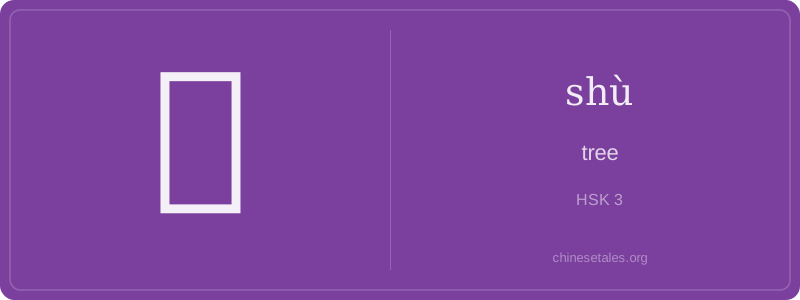
The earliest form of 树 appears in bronze inscriptions around 1000 BCE: a stylized tree with strong roots, a thick trunk, and spreading branches — sometimes even with leaves or fruit. Over centuries, the pictograph simplified: roots became the bottom strokes, the trunk solidified into the vertical line of 木, and the top branched out. By the seal script era, the right side began resembling 叔 — originally unrelated, but adopted as a phonetic guide. The modern shape retains that elegant balance: 木 on the left, grounded and natural; 叔 on the right, lending sound and subtle cultural resonance.
In classical texts like the *Analects*, trees symbolize moral cultivation: 'The gentleman is like a tree — upright, fruitful, and sheltering.' By the Tang dynasty, poets used 树 to evoke seasonal change and human transience — think of Du Fu’s line about ‘withered trees’ marking exile. Visually, the nine strokes map perfectly to arboreal logic: two strokes for roots (the double dots under 木), one for the trunk (the central vertical), three for branches (top of 木 + two strokes in 叔), and three more for structural support — nature made legible stroke by stroke.
At its heart, 树 (shù) is the living, rooted essence of 'tree' — not just a botanical term but a symbol of growth, stability, and lineage in Chinese thought. The left radical 木 (mù) means 'wood' or 'tree' and instantly anchors the character in the natural world; the right side 叔 (shū) is a phonetic component that hints at pronunciation (shù vs. shū — close enough for ancient sound shifts!) and subtly evokes familial hierarchy ('uncle'), hinting at how trees were historically linked to ancestral roots and clan identity.
Grammatically, 树 is a noun but also appears as a verb meaning 'to plant' or 'to establish' — as in 树立 (shùlì, 'to establish [a principle]'), where it’s metaphorical root-planting. Learners often mistakenly use it as a classifier (like 个), but Chinese uses 棵 (kē) for trees: *yī kē shù*, never *yī shù*. Also, avoid confusing it with 林 (lín, 'grove') or 森 (sēn, 'forest') — those are collectives, while 树 is singular and specific.
Culturally, trees appear everywhere: from Confucian metaphors ('the tree of knowledge') to feng shui (where placement of trees affects qi flow), and even in surnames like Shù (树). A common slip is misreading 树 as 'shū' — but tone matters! Shù (4th tone) is 'tree'; shū (1st tone) is 'uncle'. And no, you can’t say 'I climbed a shù' without 棵 — that would sound like saying 'I climbed a tree-tree'!