检
Character Story & Explanation
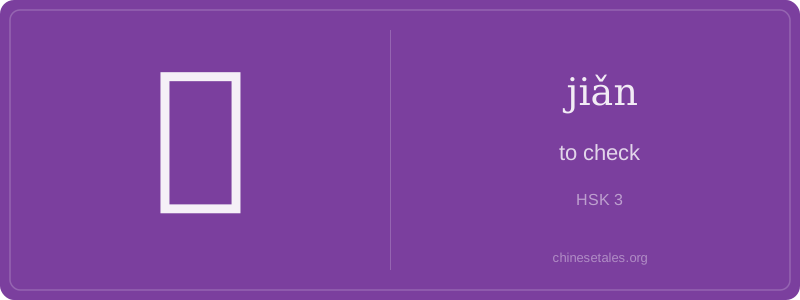
The earliest form of 检 appears in Han dynasty seal script as a complex ideograph: at the top, a simplified version of 契 (qì, ‘tally’ or ‘carved inscription’), representing official documents; below, 木 (mù, ‘wood’), referencing the wooden tally sticks used in ancient China to verify contracts or inventory — two halves carved with matching notches, then split apart. When reunited, they ‘checked’ authenticity. Over centuries, the upper component streamlined into 佥 (qiān), a phonetic-semantic compound itself meaning ‘all together’, while the lower 木 remained firmly rooted — literally and graphically anchoring the idea of verification in tangible, physical evidence.
This wood-and-tally origin shaped its semantic evolution: from verifying wooden tallies in Zhou dynasty granaries, 检 expanded in the Han to mean ‘to examine texts’ (e.g., in the bibliographic treatise 《汉书·艺文志》), then broadened during the Tang and Song to include moral self-examination (as in Neo-Confucian self-cultivation texts). The visual persistence of 木 reminds us that truth, in traditional Chinese thought, wasn’t abstract — it was something you could hold, compare, and confirm against a physical standard, like two matched pieces of wood snapping into place.
Think of 检 (jiǎn) as China’s original ‘quality control inspector’ — not in a factory, but in the imperial archives. In English, ‘check’ can be casual (‘check your email’) or rigorous (‘background check’), but 检 always carries a quiet weight of scrutiny, verification, and institutional authority. It’s rarely spontaneous: you don’t ‘check’ a friend’s mood with 检 — you 检查 their medical records, passport, or homework. That gravity comes from its ancient roots in state oversight.
Grammatically, 检 almost never stands alone — it partners with other characters to form verbs like 检查 (jiǎnchá, ‘to inspect’) or nouns like 检验 (jiǎnyàn, ‘testing’). You’ll see it as the first syllable in compound verbs, often followed by action-oriented characters (查, 验, 测). Learners mistakenly try to use it like ‘check’ in ‘I’ll check later’ — but that’s usually 看一下 or 查一下; 检 needs context implying formal assessment or official procedure.
Culturally, 检 evokes the meticulousness of traditional Chinese scholarship — where every classical text was ‘examined’ (校检) for scribal errors before printing. Modern usage preserves that ethos: airport security uses 安检 (ānjiǎn), health authorities issue 核酸检测 (hésuān jiǎncè), and even AI ethics panels talk about 算法审查 (suànfǎ shěnchá). A common mistake? Confusing it with 检 as a noun meaning ‘a document’ (rare outside legal contexts) — no, it’s strictly a verb-root character. Its power lies in its partnership, not its solo act.