甜
Character Story & Explanation
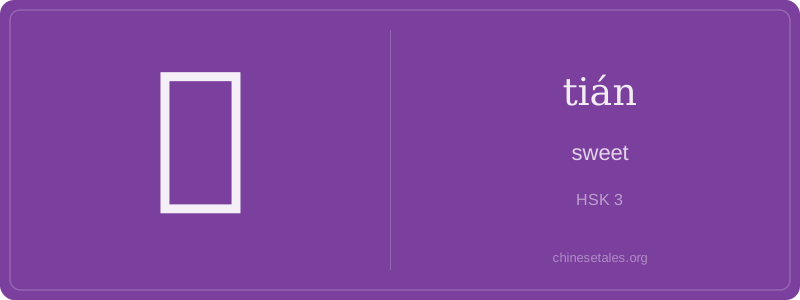
The earliest form of 甜 appears in bronze inscriptions as a combination of 甘 (a pictograph of a mouth with a tongue-shaped stroke inside, representing 'sweet taste') and 舌 (tongue) — literally 'tongue tasting sweetness'. Over time, 舌 simplified and rotated, becoming the right-hand component 甛 (an older variant), then further stylized into today’s 甘 + 舀 (yǎo, 'to scoop') — though 舀 here is purely phonetic, not semantic. The modern 甜 has 11 strokes: six for the left 甘 (which itself means 'sweet' and is a standalone character), and five for the right 舀 — a classic example of a phono-semantic compound where the radical hints at meaning and the phonetic hints at sound (though tián and yǎo aren’t perfect homophones, they share historical phonetic links).
This character first appeared in texts like the *Shuō Wén Jiě Zì* (121 CE), defined as 'mellow, pleasant taste', and quickly expanded beyond food. By the Tang dynasty, poets used 甜 to describe melodic poetry ('音韵甚甜') and charming speech ('言辞清甜'). Its visual duality — 甘 (sweetness) paired with 舀 (a gesture of gathering, scooping up delight) — mirrors how Chinese conceptualizes sweetness as something actively savored, shared, and gathered into life’s small joys.
Imagine biting into a ripe mango in Guangzhou’s summer heat — that instant burst of nectar flooding your mouth, your shoulders relaxing, a little smile escaping. That’s 甜 (tián): not just a taste, but a full-body sigh of pleasure. In Chinese, it’s the go-to word for literal sweetness (sugar, fruit, desserts), but also extends emotionally — a ‘sweet’ voice, a ‘sweet’ memory, even a ‘sweet’ deal. It’s an adjective that can stand alone ('很甜') or modify nouns directly ('甜茶'), and unlike English, it rarely needs 'taste' or 'flavor' to be implied.
Grammatically, 甜 behaves like most HSK-3 adjectives: use 很 before it for neutral description ('这蛋糕很甜'), 不 for negation ('这咖啡不甜'), and 太/有点 for degree ('太甜了!' / '有点甜'). Watch out — learners often overuse 甜 for 'cute' (that’s 可爱) or 'pleasant' (that’s 舒服 or 愉快). Also, don’t confuse it with 甘 (gān), its radical — which *means* 'sweet' too but appears only in literary compounds like 甘心 ('willingly') and isn’t used standalone.
Culturally, 甜 carries warmth and goodwill: calling someone’s child 小甜心 ('little sweet heart') is affectionate, not sugary; saying 生活很甜 ('life is sweet') expresses quiet contentment, not hedonism. And yes — in internet slang, 甜 can describe overly saccharine romance dramas (甜宠剧), where every glance sparkles like honey. So 甜 isn’t just sugar — it’s the linguistic syrup that glazes joy, comfort, and gentle charm.