留
Character Story & Explanation
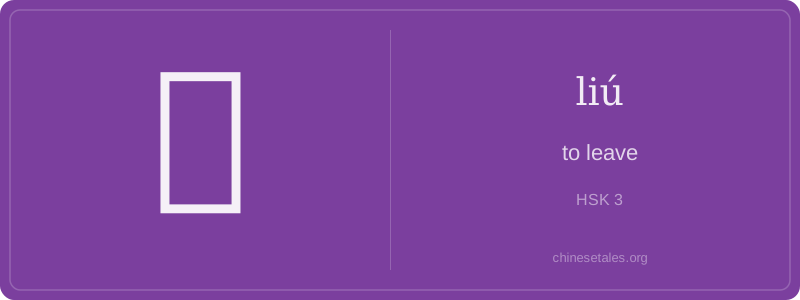
The earliest form of 留 appears in bronze inscriptions as a complex pictograph: a kneeling person (the top component, now simplified to 丷 + 一 + 田) holding a stalk of grain over a field (田). Scholars believe it depicted 'staying behind to guard the harvest' — literally, 'to remain in the field'. Over centuries, the kneeling figure morphed into the upper part (丷 + 一), while the field (田) stayed intact as the radical — anchoring the idea of grounded, territorial staying. The lower part (厶 + 田) evolved into the modern 留’s distinctive 'enclosed field with a loop', suggesting containment and continuity.
This agricultural origin explains why 留 quickly expanded beyond physical presence: in the Analects, Confucius says 君子成人之美,不成人之恶。小人反是 (Jūnzǐ chéng rén zhī měi, bù chéng rén zhī è. Xiǎorén fǎn shì) — where 成 (chéng, 'to complete') and 留 subtly intertwine in classical usage: to 'leave' or 'preserve' virtue was as vital as sowing seeds. Even today, the character’s visual weight — ten strokes, balanced and centered — mirrors its semantic role: a stable anchor in sentences about memory, commitment, and legacy.
At first glance, 留 (liú) feels like a gentle word — 'to stay', 'to remain', 'to leave behind' — but its energy is quietly insistent. Unlike passive verbs like 在 (zài, 'to be at'), 留 implies *intentional retention*: you choose to keep something or someone in place — whether it’s your luggage at the hotel, a memory in your heart, or a friend for dinner. It’s not accidental lingering; it’s deliberate holding-on.
Grammatically, 留 shines in two key structures: (1) as a verb meaning 'to leave (something) somewhere' — e.g., 留下 (liú xià, 'to leave behind') or 留在 (liú zài, 'to remain at'); and (2) as part of the common resultative complement pattern 留 + location/direction, like 他把钥匙留在我家 (Tā bǎ yàoshi liú zài wǒ jiā, 'He left the keys at my place'). Watch out: learners often mistakenly use 留 for 'to stay' without specifying *what* is being retained — remember, 留 almost always carries an object or clear context of retention.
Culturally, 留 echoes Confucian values of preservation — keeping tradition, keeping promises, keeping people close. That’s why 留学 (liúxué, 'study abroad') literally means 'to stay (and study) overseas': it’s not just travel, but a purposeful, sustained presence. A classic learner trap? Using 留 when you mean 停 (tíng, 'to stop') — 留 is about *continuing presence*, not pausing motion. And never say 我留 here — say 我留下来 or 我留在这里!