画
Character Story & Explanation
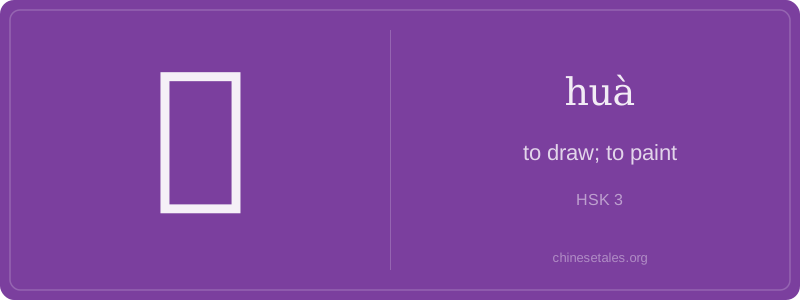
The earliest form of 画 appears in bronze inscriptions around 1000 BCE: a stylized hand holding a brush-like tool hovering over a rectangular shape — likely representing a surface (a silk scroll? a clay tablet?) waiting to be marked. Over centuries, the hand evolved into the left-side component (聿 yù, an ancient word for ‘writing brush’), while the right side solidified into 田 — not as ‘field’, but as a simplified boundary or frame, evoking the contained space where art happens. By the Han dynasty, the modern eight-stroke form emerged: three horizontal strokes top the 田, and the vertical stroke on the left anchors the whole gesture of creation.
This evolution mirrors Chinese aesthetics: art isn’t wild chaos — it’s disciplined expression within structure. Confucius praised ‘the harmony of ritual and music’, and 画 embodies that balance — freedom of line, bounded by form. In the Classic of Poetry, ‘drawing’ appears metaphorically: ‘He draws virtue like ink on silk’ — suggesting moral cultivation as an artistic act. Even today, calligraphers begin each session by ‘drawing the square’ (画方 huà fāng) — not as geometry, but as centering the mind before the first stroke. The 田 isn’t farmland; it’s the quiet, fertile ground where vision becomes visible.
At its heart, 画 (huà) isn’t just ‘to draw’ — it’s the act of *bringing something into visible form*, whether with brush, chalk, or even imagination. Unlike English verbs that separate ‘draw’, ‘paint’, and ‘sketch’, 画 covers all of them fluidly. It feels deliberate, artistic, and slightly formal — you’d say 画一幅画 (huà yī fú huà, ‘draw a painting’) but rarely use it for doodling in a notebook (that’s more 涂鸦 túyā). The character itself breathes intention: every stroke matters, and so does every object it modifies.
Grammatically, 画 is wonderfully flexible: it’s a verb (她正在画猫 — tā zhèngzài huà māo, ‘She’s drawing a cat’), a noun (这幅画真美 — zhè fú huà zhēn měi, ‘This painting is beautiful’), and even part of compound verbs like 画画 (huà huà, ‘to draw/doodle’ — reduplication softens it, making it casual and childlike). Watch out: learners often mistakenly treat 画 as only a noun (‘a painting’) and forget its powerful verb use — or worse, confuse it with similar-sounding words like 化 (huà, ‘to transform’), which shares the sound but none of the artistry.
Culturally, 画 carries centuries of reverence for visual expression — from Song dynasty ink masters to modern cartoonists. Interestingly, it appears in bureaucratic phrases too: 划 (huà, same pronunciation but different character) means ‘to allocate’, and people sometimes miswrite 画 when they mean 划 in official contexts — a tiny stroke error that could accidentally turn ‘allocate funds’ into ‘paint funds’! Also, note the radical: 田 (tián, ‘field’) isn’t about farming here — it’s a phonetic clue (ancient pronunciations aligned), not semantic. Don’t overthink the ‘field’ — this character is all about the hand guiding the brush.