糕
Character Story & Explanation
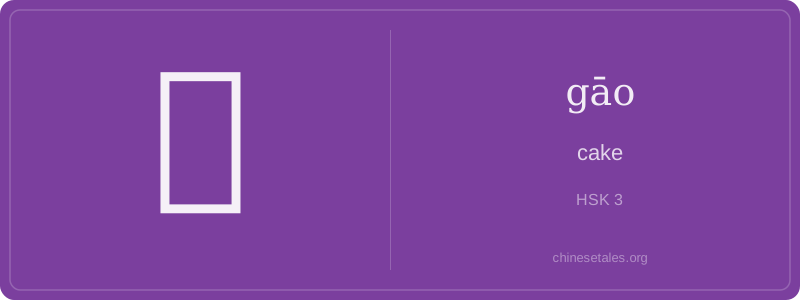
The earliest form of 糕 appears in Han dynasty seal script, not oracle bones — because it’s a relatively late semantic compound, invented after rice milling and steaming techniques matured. Visually, it combines 米 (mǐ, 'rice') on the left — depicting grains in a sack-like shape — with 羊 (yáng, 'sheep') on the right. Wait — sheep? Yes! But not for meat: in ancient China, 'sheep' was a phonetic component (羊 sounded close to gāo in Old Chinese) *and* carried auspicious symbolism (sheep = gentleness, prosperity). Over centuries, the right side simplified from full 羊 to the modern 皋 (gāo) — a stylized version preserving both sound and elegance.
This character crystallized during the Tang-Song transition, when rice-based confections became status symbols among scholars and officials. The poet Su Dongpo wrote fondly of ‘snow-white rice cakes’ served with plum sauce — linking 糕 to refinement and seasonal awareness. Crucially, its visual structure reflects its essence: 米 anchors it in agriculture and sustenance; the right side sings its name and blessing. Even today, when elders gift 年糕 before Spring Festival, they’re handing over not just food — but a silent, edible pun for 'a higher year.'
Think of 糕 (gāo) not as just 'cake' in the Western sense — fluffy, frosted, and oven-baked — but as a deeply traditional, often steamed or pounded, grain-based delicacy rooted in ritual, celebration, and texture. Its core feeling is softness, sweetness, and auspiciousness: in Chinese culture, saying 'gāo' sounds identical to 高 (gāo, 'high'), so eating 糕 is literally 'eating high' — a playful homophone wish for rising fortunes, promotions, or longevity. That’s why you’ll find it at birthdays, Lunar New Year, and Double Ninth Festival.
Grammatically, 糕 functions almost exclusively as a noun — never a verb or adjective — and rarely stands alone. It appears in compound nouns like 年糕 (nián gāo) or 米糕 (mǐ gāo), where the first character specifies the type or occasion. Learners sometimes mistakenly use it like English 'cake' in phrases such as 'I made cake' — but in Chinese, you’d say 我做了年糕 (wǒ zuò le nián gāo), naming the specific kind. Omitting the modifier feels vague, even odd — like saying 'I ate pastry' without specifying if it’s croissant, muffin, or mooncake.
Culturally, its 米 (rice) radical tells the whole story: this isn’t wheat-based; it’s rice-based — sticky, chewy, labor-intensive. Many regional varieties (like Shanghai’s glutinous water-mill rice cakes or Fujian’s layered oiled cakes) require pounding or soaking overnight. A common learner trap? Assuming all 'cakes' are sweet — but some savory versions exist (e.g., 萝卜糕, luóbo gāo, turnip cake). Also, don’t confuse it with bread (面包, miànbāo) or pie (派, pài) — those belong to entirely different culinary and linguistic families.